Solar Rooftop Installation in Whitefield, Bangalore: Local Guide (2026)
Whitefield’s rapid expansion over the past two decades — from a sleepy IT outpost to one of east Bangalore’s densest residential corridors — has come with predictable side effects. Electricity demand has grown faster than infrastructure upgrades in many pockets. BESCOM tariff slabs have crept upward. Residents in independent villas, gated communities, and standalone homes are paying ₹4,000 to ₹15,000 a month for grid power that flickers more often than it should.
Rooftop solar solves both problems at once. This guide is specifically for Whitefield homeowners considering solar — what makes the area particularly suited to solar adoption, BESCOM net metering specifics for the east Bangalore feeder network, what installations typically cost here, and what’s worth knowing about local roof conditions, shadow patterns, and the post-monsoon installation window.
Why Whitefield is Particularly Well-Suited for Rooftop Solar
Whitefield sits roughly 18 km east of central Bangalore at coordinates approximately 12.97°N, 77.75°E — the same solar insolation band as the rest of Bangalore, with annual average sunlight of about 5.0–5.5 kWh/m²/day. Translation: a 5 kW system installed in Whitefield generates 7,000–8,000 units of electricity per year, the same as anywhere else in Bangalore.
What makes Whitefield specifically attractive for solar:
- High electricity consumption baseline. Whitefield homes typically run 2–4 ACs given how dense the area gets in summer, plus geysers, dishwashers, and the rest of an upper-middle-class load profile. Monthly bills of ₹5,000–₹12,000 are common. Higher consumption = more savings absorbed by solar = faster payback.
- Independent villa and gated community housing stock. Unlike denser parts of central Bangalore, Whitefield has many independent homes and gated community villas with proper rooftop access and minimal shading from neighboring buildings.
- BESCOM service area. Whitefield is fully within BESCOM territory, which means PM Surya Ghar Muft Bijli Yojana subsidies (up to ₹78,000) and net metering are both available. The complete BESCOM net metering process is covered in a separate guide.
- Power reliability frustrations drive interest. Whitefield’s electricity infrastructure hasn’t kept pace with the area’s growth. Voltage fluctuations and outages, particularly during pre-monsoon afternoons and high-summer evenings, make grid power feel less reliable than it should be — pushing more residents toward solar with hybrid backup configurations.
What Solar Costs in Whitefield (Realistic 2026 Prices)
System costs in Whitefield don’t differ materially from the rest of Bangalore — solar equipment is sourced nationally and installation labor pools serve the entire metro area. Realistic price ranges for residential systems:
- 3 kW system: ₹1.8 lakh – ₹2.4 lakh gross (₹1.0–₹1.6 lakh net after ₹78,000 PM Surya Ghar subsidy)
- 5 kW system: ₹2.9 lakh – ₹3.5 lakh gross (₹2.1–₹2.7 lakh net after subsidy)
- 10 kW system: ₹5.5 lakh – ₹6.8 lakh gross (₹4.7–₹6.0 lakh net — subsidy caps at ₹78,000)
For most Whitefield homes consuming 600–1,000 units per month, a 5 kW system is the sweet spot. For larger villas with 1,500+ units of monthly consumption, 7–10 kW makes sense — though note that the PM Surya Ghar subsidy caps at 3 kW capacity, so the incremental cost of going above 5 kW is unsubsidized. The full cost breakdown for 5 kW systems in Bangalore is covered in a separate guide.
Whitefield-Specific Considerations
Roof structure variability
Whitefield housing stock is more varied than older parts of Bangalore. You see everything from independent villas with sloped tile roofs to flat-roofed bungalows to penthouse-style terrace homes in low-rise apartments. Each requires different mounting approaches:
Shading from neighboring construction
Whitefield’s continued construction means that even an unshaded roof today could be partially shaded in two years if a new apartment goes up next door. A proper site survey factors in not just current shading but predicted future shading based on what’s permitted or under construction nearby. Microinverters or DC optimizers (which let unshaded panels operate at full capacity even when others are partially shaded) become worth considering for homes facing this risk.
Voltage stability and hybrid system case
Whitefield experiences voltage dips and brief outages more often than central Bangalore. For homes with sensitive electronics (work-from-home setups, home labs, refrigerators stocked with medication), a hybrid system with battery backup is worth considering. Hybrid configuration adds roughly ₹1.5–₹3 lakh to a 5 kW system but provides 4–8 hours of essential-load backup during outages.
If you don’t need full backup but want the system to keep running during BESCOM grid outages (rather than auto-shutting down per safety regulations), a smaller battery sized just for critical loads — Wi-Fi router, refrigerator, a few lights — is a more affordable middle ground.
Best installation window
Post-monsoon (October to February) is the ideal installation window in Whitefield. Roofs are dry, working conditions are pleasant for installation crews, and BESCOM net metering processing tends to be faster outside the peak summer rush. Avoid mid-monsoon (June–September) installations where possible — both for practical installation difficulty and because BESCOM inspection delays are longest during this period.
BESCOM Net Metering for Whitefield Addresses
Whitefield is fully in BESCOM service territory, which means the standard net metering process applies. A few things specific to the east Bangalore feeder network worth knowing:
- Technical feasibility checks in densely-built Whitefield pockets (around ITPL, Brookefield, Hagadur) sometimes flag transformer capacity issues for larger systems. Your installer should check feeder capacity before finalizing system size.
- Application processing times through the BESCOM East division (which handles Whitefield) typically run 4–6 weeks from submission to commissioning, occasionally faster.
- Apartment installations require additional documentation: written approval from the resident welfare association (RWA) or apartment owners’ association.
What 5 kW Solar Actually Looks Like on a Whitefield Home
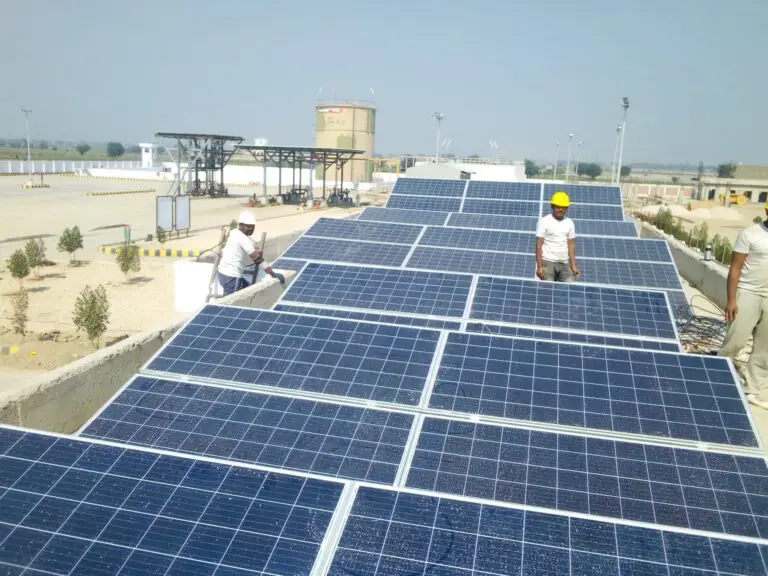
A 5 kW system requires approximately 350–500 sq ft of unshaded roof area. For most Whitefield independent villas with 1,200–2,400 sq ft built-up area, this is easily available even on partial roof sections. Apartment penthouse units may have less, but 3 kW systems (200–300 sq ft) often fit on terrace spaces.
Physical installation in Whitefield typically takes 3–5 working days for a 5 kW system. End-to-end from initial site survey to commissioning (including BESCOM paperwork) averages 4–7 weeks if there are no complications, longer if your sanctioned BESCOM load needs enhancement or if your apartment association approval process takes time.
Realistic Savings: What Whitefield Homeowners Actually See
For a Whitefield home consuming 800 units per month and paying ₹6,000–₹7,000 monthly to BESCOM, a 5 kW solar system typically takes the monthly bill to near zero, with credits accumulating in lower-consumption months that offset higher-consumption summer months. Annual savings: ₹60,000–₹75,000 in current tariffs.
Over the 25-year system life, accumulated savings exceed ₹15–20 lakh in undiscounted electricity costs (and substantially more accounting for tariff escalation). On a net investment of approximately ₹2.4–₹2.7 lakh after subsidy, the return profile is stronger than most fixed-income investments available to retail investors.
Eltron Energy — Solar Installation in Whitefield
Eltron Energy has installed rooftop solar systems across east Bangalore including Whitefield, Brookefield, ITPL Road, Kadugodi, and the surrounding micro-localities. We’re empanelled with both BESCOM and PM Surya Ghar, which means we handle the entire net metering and subsidy paperwork on your behalf — you don’t fill forms or coordinate with BESCOM yourself.
Every installation uses Tier-1 panels (Waaree, Vikram Solar, or equivalent), reputed inverters (Sungrow, Growatt, or Fronius depending on system requirements), and hot-dip galvanized iron mounting structures rated for 25-year service life. Each installation is backed by the Eltron Assure program — 5 years of guaranteed performance with compensation if your system underdelivers.
Get in touch for a free site survey at your Whitefield address. Share your monthly electricity bill, approximate roof area, and BESCOM consumer number — we’ll send a personalized system design, subsidy estimate, and quote within 24 hours.