Solar Rooftop Installation in Electronic City, Bangalore: Local Guide (2026)
Electronic City has grown into one of south Bangalore’s largest residential corridors, anchored by Infosys, Wipro, and a dense cluster of IT campuses that brought tens of thousands of families to set up homes within a 5–10 km radius. The result: a residential belt running from Bommasandra through Konappana Agrahara to Hosa Road and Singasandra, with monthly electricity bills that have climbed steadily alongside the area’s growth.
If you live in Electronic City Phase 1 or Phase 2, Bommasandra, or any of the surrounding residential pockets and you’re thinking about rooftop solar, this guide covers what’s specific to your area — the solar potential, BESCOM net metering through the south Bangalore feeder, realistic system costs, local installation considerations, and what payback looks like at Electronic City’s electricity consumption profile.
Why Electronic City Works Well for Rooftop Solar
Electronic City sits at roughly 12.84°N, 77.66°E — slightly south of central Bangalore but in the same solar insolation zone, receiving approximately 5.0–5.5 kWh/m²/day of average solar energy. A 5 kW system here generates 7,000–8,000 units per year, the same as the rest of the metro.
What makes Electronic City particularly suited to solar adoption:
- High monthly electricity bills. The combination of IT salaries, work-from-home setups, multiple ACs, and energy-intensive lifestyle pushes Electronic City households into the upper BESCOM tariff slabs faster than most areas. Monthly bills of ₹4,500–₹10,000 are common, and the marginal cost of grid electricity at these slabs exceeds ₹8 per unit — exactly the range where solar economics work hardest.
- Independent villa + gated community housing. Layouts like Doddathoguru, Konappana Agrahara, and the planned developments off Hosur Road have strong rooftop access. Gated community villas often share solar policies across the community, simplifying the BESCOM approval process when neighbors have already installed.
- BESCOM service area. Electronic City falls within BESCOM territory (not Karnataka’s other DISCOMs), which means PM Surya Ghar Muft Bijli Yojana subsidies up to ₹78,000 and standard net metering apply. The complete BESCOM net metering process is covered in a separate guide.
- Open layouts with less shading. Compared to denser central Bangalore neighborhoods, Electronic City residential pockets typically have fewer multi-story buildings creating roof shadow problems on neighboring homes — making system performance more predictable.
Electronic City Solar Costs in 2026
System pricing in Electronic City matches the broader Bangalore market — equipment is sourced nationally and installer cost structures are similar across the metro. Realistic ranges for residential systems:
- 3 kW system: ₹1.8–₹2.4 lakh gross (₹1.0–₹1.6 lakh net after ₹78,000 subsidy) — sized for monthly bills of ₹2,500–₹4,000
- 5 kW system: ₹2.9–₹3.5 lakh gross (₹2.1–₹2.7 lakh net) — the most common size for Electronic City homes; offsets ₹4,500–₹7,000 monthly bills
- 10 kW system: ₹5.5–₹6.8 lakh gross (₹4.7–₹6.0 lakh net) — for villas with monthly bills above ₹10,000
For most Electronic City households, the 5 kW system is the right size — large enough to zero out a typical bill and small enough to capture the full PM Surya Ghar subsidy (which caps at 3 kW capacity but reaches the ₹78,000 ceiling regardless of whether you install 3 kW or 10 kW). A complete cost breakdown for 5 kW systems in Bangalore is covered in a separate guide.
Considerations Specific to Electronic City
Approach varies by neighborhood character
Electronic City Phase 1 and Phase 2 have very different housing profiles. Phase 1 (the older, denser pocket around the Infosys main campus) has more apartment buildings and compact independent homes. Phase 2 (further south, toward Doddathoguru and Konappana Agrahara) has more villa-style independent homes with larger plots and roof areas.
- Independent villas are the most straightforward installation — typically 350–500 sq ft of unshaded roof for a 5 kW system fits easily.
- Row houses and townhouses common in gated communities can do 3–5 kW comfortably depending on individual roof area.
- Apartment installations require approval from the resident welfare association (RWA). Many Electronic City apartment associations have established solar approval processes — others haven’t, and getting approval can take 2–6 weeks of association meetings.
BESCOM South division processing
Electronic City applications are processed through BESCOM’s south division, which currently handles a high volume of solar applications given the area’s growth. Realistic timelines from application submission to commissioning run 4–7 weeks. Transformer capacity in Electronic City has generally kept up with residential solar demand — technical feasibility approvals tend to come through cleanly for systems up to 10 kW.
Hosur Road dust factor
Homes within roughly 2 km of Hosur Road (NH-44) experience higher airborne dust deposition on solar panels than homes deeper inside residential zones. This doesn’t disqualify solar — modern panels with anti-soiling glass coatings handle dust well — but it does mean panel cleaning needs to be more frequent. Plan for monthly cleaning if you’re close to the highway, versus every 6–8 weeks for homes farther inside.
Construction-corridor shading risk
Electronic City Phase 2 continues to see new construction. An unshaded roof today could face partial shading from a new apartment going up next door in 18–24 months. A proper site survey accounts for current and predicted future shading. For roofs with this risk, microinverters or DC optimizers (which let individual panels operate at full output even when neighboring panels are partially shaded) become worth the additional cost — typically adding ₹40,000–₹70,000 to a 5 kW system but protecting performance for the full 25-year system life.
Realistic Savings for Electronic City Homes
For an Electronic City home consuming 700–900 units monthly and paying ₹5,500–₹7,500 to BESCOM, a 5 kW system typically takes the monthly bill to zero, with credits rolling forward to absorb high-consumption summer months. Annual savings: ₹65,000–₹80,000 in current tariffs, more as BESCOM tariffs rise over time.
Over 25 years of system life — and Tier-1 panels carry 25-year performance warranties guaranteeing at least 80% output at year 25 — accumulated savings exceed ₹18–25 lakh in undiscounted electricity costs. Payback on a ₹2.4 lakh net investment lands between year 3 and year 4 for most Electronic City households, after which it’s two decades of essentially free power.
What 5 kW Looks Like Physically
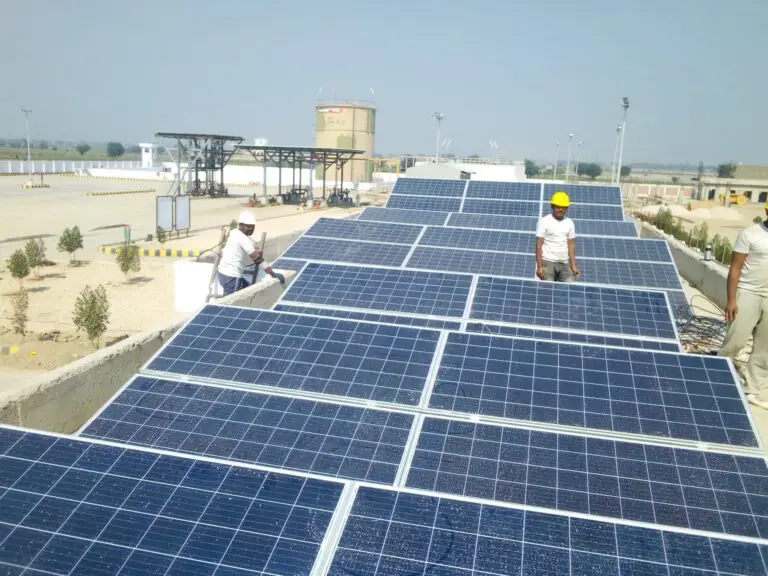
A 5 kW residential system uses 9–12 solar panels depending on individual panel wattage (typical Tier-1 panels in 2026 are 540–580W). Total roof area required: 350–500 sq ft of unshaded space, ideally facing south or south-east for optimal generation. The panels sit on hot-dip galvanized iron mounting structures with appropriate tilt angle for Bangalore’s latitude.
Physical installation takes 3–5 working days on-site for a typical residential system. End-to-end from initial site survey through BESCOM commissioning: 4–7 weeks for straightforward installations, longer if your apartment association approval or BESCOM load enhancement adds steps.
Eltron Energy — Solar Installation in Electronic City
Eltron Energy has installed rooftop solar systems across south Bangalore including Electronic City Phase 1 and Phase 2, Bommasandra, Konappana Agrahara, Doddathoguru, Hosa Road, and Singasandra. We’re empanelled with both BESCOM and the PM Surya Ghar national portal — the entire net metering and subsidy paperwork is handled on your behalf.
Every installation uses Tier-1 panels (Waaree, Vikram Solar, Premier Energies, or equivalent), reputed inverters (Sungrow, Growatt, or Fronius matched to system requirements), and hot-dip galvanized iron mounting structures rated for 25-year service. Each system is backed by the Eltron Assure program — 5 years of guaranteed performance with compensation if the system underdelivers.
Get in touch for a free site survey at your Electronic City address. Share your monthly electricity bill, approximate roof area, and BESCOM consumer number — you’ll get a personalized system design, subsidy estimate, and quote within 24 hours.