12 Questions to Ask Your Solar Installer Before Signing a Contract
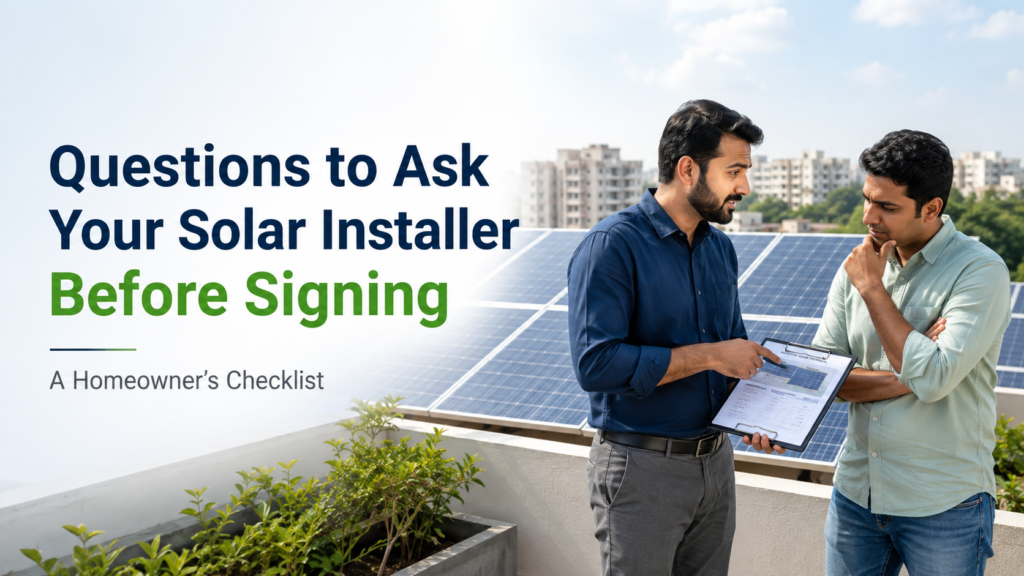
Installing rooftop solar is not something most homeowners do twice.
Once the panels are on your roof, the system could stay there for the next two decades or more. That makes choosing the right solar installer just as important as choosing the panels themselves.
And this is where many homeowners make a mistake.
They compare three quotations, look at the final price and choose the cheapest one.
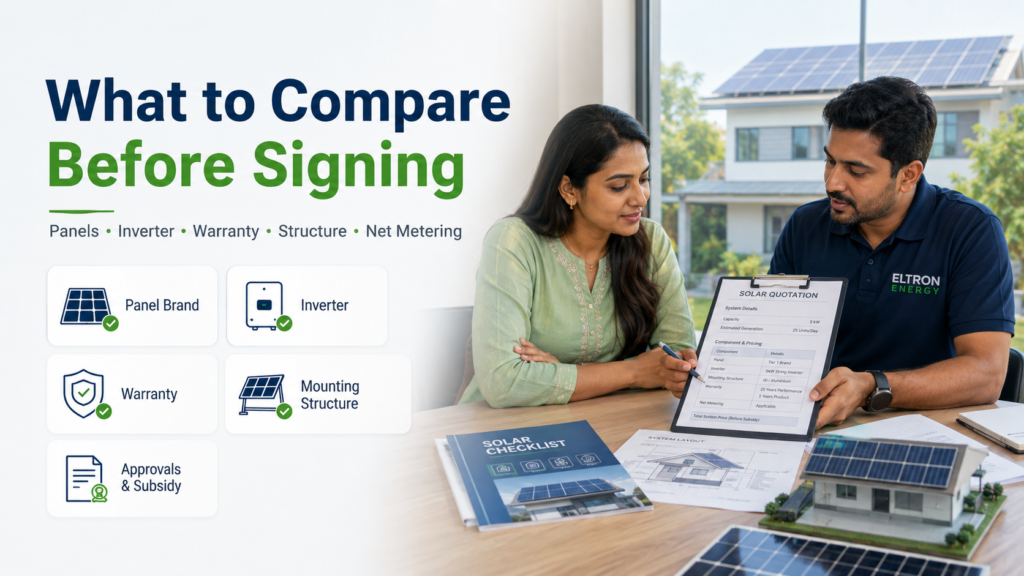
But two quotations for the same 3 kW or 5 kW solar system can be very different once you look at the panel brand, inverter, mounting structure, electrical protection, installation quality, warranty and after-sales service.
So before signing with any solar installer in Bangalore, ask these questions.
They can save you from expensive surprises later.
1. How Did You Decide the Solar System Size for My Home?
A professional installer should not recommend a 3 kW, 5 kW or 10 kW system simply because it is a popular package.
The recommendation should be based on your actual electricity consumption.
Ideally, the installer should review several months of electricity bills and understand:
- Your average monthly electricity usage
- Your daytime power consumption
- Your available rooftop space
- Shadow-free area
- Roof orientation
- Current sanctioned electrical load
- Possible future electricity requirements
For example, if you plan to buy an electric vehicle, install additional air conditioners or expand your home, your future electricity demand may be higher than it is today.
The right solar system is not necessarily the biggest system.
It is the system designed around your actual requirement.
2. Which Solar Panel Brand and Model Will You Install?
Never accept an answer such as:
“We use premium panels.”
Ask for the exact manufacturer, technology, wattage and model number.
Knowing the exact panel allows you to check its specifications, warranty and manufacturer reputation before installation.
For projects covered by applicable government schemes and net-metering requirements, homeowners should also understand whether the proposed equipment meets the required MNRE specifications and eligibility conditions.
A trustworthy installer should be comfortable putting the exact equipment details in your quotation.
If the company refuses to specify the panel model until installation day, that is a warning sign.
3. Which Inverter Are You Using?
Solar panels usually receive most of the attention, but the inverter is one of the most important components in the entire system.
It converts the electricity generated by your panels into usable electricity for your home.
Ask your installer:
What brand is the inverter?
What capacity is it?
What warranty comes with it?
Does it provide online monitoring?
Can I see solar generation through an app?
Who handles repairs if the inverter develops a problem?
A good system needs both quality panels and a reliable inverter.
Saving money on the inverter just to make the quotation look cheaper can become expensive later.
4. What Exactly Is Included in the Quoted Price?
This question is extremely important when comparing solar quotations.
One installer may quote a lower price but exclude work that another installer has already included.
Ask for a clear breakdown covering the complete installation.
This may include solar panels, inverter, mounting structure, DC and AC cables, earthing, electrical protection equipment, installation labour, transport, monitoring system, documentation and other required components.
Also ask whether there could be additional charges because of your roof condition, height of the structure, cable length or electrical modifications.
You should know the likely final project cost before signing — not after installation begins.
5. What Type of Mounting Structure Will You Use?
The solar panels may get all the attention, but the structure underneath them is what physically holds the system on your roof year after year.
Ask what material is being used.
Ask how the structure is protected against corrosion.
Ask how it will be anchored.
And most importantly, ask whether the structure is being designed specifically for your rooftop.
A residential terrace in Bengaluru is different from an industrial metal roof or a high-rise structure exposed to stronger wind conditions.
The mounting design should suit the property.
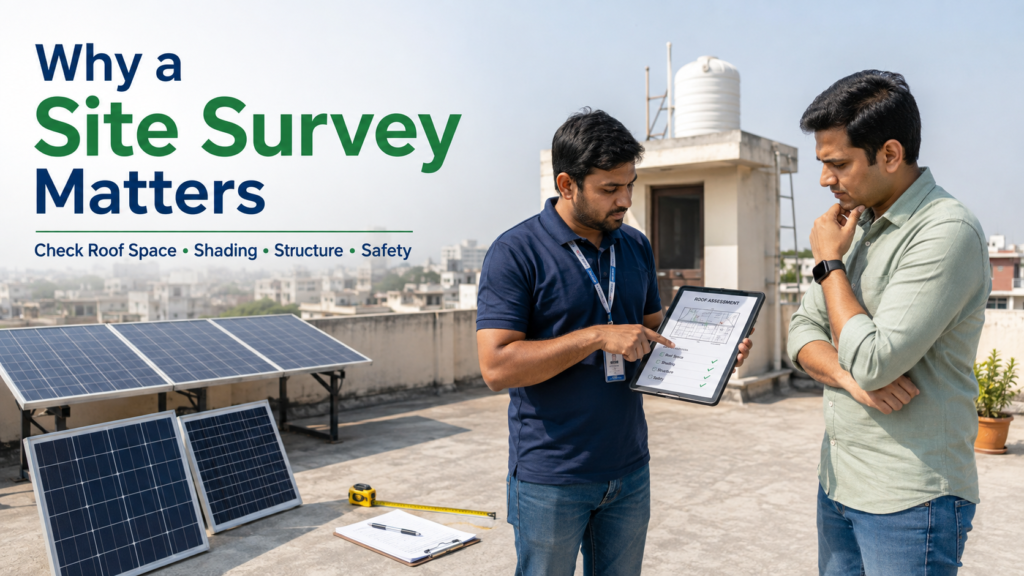
6. Have You Checked Shading on My Roof?
A roof can look sunny when you visit it at noon and still have significant shading during other parts of the day.
Nearby buildings, trees, water tanks, parapet walls, antennas and other structures can reduce solar generation.
Before finalizing the system, the installer should evaluate the usable shadow-free area.
Ask them to explain where the panels will be placed and why.
A slightly different panel layout can sometimes produce better long-term output than simply filling every available part of the terrace.
7. How Much Electricity Should This System Actually Generate?
Be careful with unrealistic promises.
Solar generation varies with system size, panel efficiency, sunlight, weather, shading, orientation, temperature, maintenance and several other factors.
Instead of accepting statements like:
“Your electricity bill will become zero.”
Ask the installer for an estimated annual generation figure based on your proposed system.
Then ask how that estimate was calculated.
A reliable installer should explain expected performance instead of guaranteeing an impossible electricity bill.
Your remaining grid bill can also depend on your consumption pattern, fixed charges and how your electricity connection and net-metering arrangement operate.
8. Will You Handle BESCOM and Net-Metering Work?
For homeowners in Bengaluru, the installation itself is only one part of the process.
There can also be documentation, approvals, inspections and net-metering procedures associated with connecting a rooftop solar system to the grid.
Ask the installer exactly what they handle.
Will they assist with the application?
Will they prepare the documents?
Will they coordinate the required approval process?
Will they assist until the system is commissioned?
An experienced rooftop solar company should be able to clearly explain the process instead of leaving you to figure everything out after payment.
9. Can I Get the PM Surya Ghar Subsidy?
If you are installing eligible residential rooftop solar, ask whether your project qualifies under the applicable government rooftop-solar subsidy framework.
But don’t stop at:
“Yes, you will get subsidy.”
Ask how the process works.
Ask what equipment requirements apply.
Ask what documents are required.
Ask which part of the process is handled by the installer and which part needs to be completed by you.
Government schemes have eligibility and technical requirements, so the system should be planned correctly from the beginning.
Never choose equipment first and ask about subsidy eligibility later.
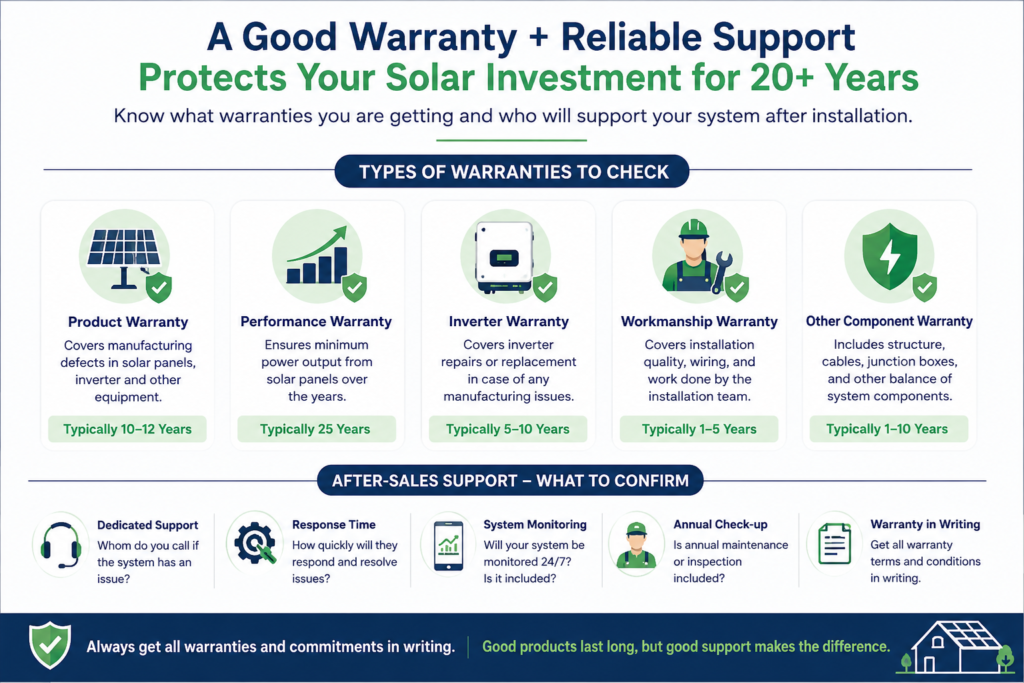
10. What Warranty Am I Actually Getting?
The word “25-year warranty” sounds impressive, but you need to know exactly what it covers.
Solar projects can involve several different warranties.
There may be a product warranty on the solar modules, a performance warranty, an inverter warranty, workmanship coverage and warranties for other components.
Ask for the warranty terms in writing.
Also ask an even more practical question:
If something fails three years from now, whom do I call?
The manufacturer?
The installer?
A service centre?
The quality of after-sales support is often more important than a warranty number printed on a brochure.
11. What Maintenance Will the System Need?
Solar systems generally require relatively little routine maintenance, but “low maintenance” does not mean “no maintenance.”
Dust, bird droppings, leaves and other dirt can reduce the amount of sunlight reaching the panels.
Connections and electrical components should also be inspected periodically.
Ask your installer what maintenance is recommended and what is included after installation.
Also find out whether system generation will be monitored.
If production suddenly falls, monitoring can make it much easier to identify the problem quickly.
12. Can You Show Me Previous Installations?
Before paying a significant advance, ask to see previous rooftop solar projects.
Even better, ask whether the installer has completed projects similar to yours.
If you own an independent home, look at residential installations.
If you have a commercial building, ask for comparable commercial work.
Look at how panels are arranged, how cables are routed, how the mounting structure is finished and how neat the overall installation appears.
Solar installation is both electrical work and structural work.
Good workmanship is usually visible.
Don’t Compare Solar Companies Only by Price
Imagine you receive two quotations.
Company A is ₹20,000 cheaper.
Company B includes a better inverter, stronger mounting structure, better electrical protection, professional documentation and dependable after-sales service.
On paper, Company A wins.
Over the next 20–25 years, Company B may easily turn out to be the better investment.
The cheapest solar installation is not always the one with the lowest quotation.
It is the system that produces dependable electricity with minimal problems for years.
A Simple Rule Before You Sign
Before choosing a solar installer, you should clearly understand five things:
What equipment are you getting?
How much electricity should it produce?
What is included in the price?
Who handles approvals and documentation?
Who will support the system after installation?
If the installer gives clear, specific answers, that is a positive sign.
If the answers keep changing or important details cannot be provided in writing, think carefully before paying an advance.
Looking for a Rooftop Solar Installer in Bangalore?
Instead of recommending a system only from a phone conversation, the right approach is to understand your electricity consumption, rooftop conditions, available space and project requirements before finalizing the design.
If you’re considering rooftop solar, you can start with a site survey and quotation.
Bring your electricity bill and ask every question in this guide.
A good solar company shouldn’t be uncomfortable answering them.
Talk to Eltron Energy and get a rooftop solar system designed around your actual electricity needs.
By Eltron Energy Editorial Team | August 28, 2026