How Many Solar Panels Do I Need for My House in Bangalore? 2026 GuideHow Many Solar Panels Do I Need for My House in Bangalore? 2026 Guide
You have decided to install solar.
Then comes the next question:
“How many solar panels do I actually need for my house?”
It sounds like a simple question, but the correct answer is not based on the size of your house alone.
A 2,000 sq ft house occupied by two people might consume less electricity than a 1,200 sq ft home running three air conditioners, a water heater, multiple appliances and an EV charger.
That is why a good solar installer should never recommend a system just by looking at your home’s square footage.
The starting point should be your actual electricity consumption.
If you live in Bangalore or elsewhere in Karnataka and are trying to work out whether you need 4 panels, 6 panels, 10 panels or more, this guide will make the calculation much easier.
The Short Answer
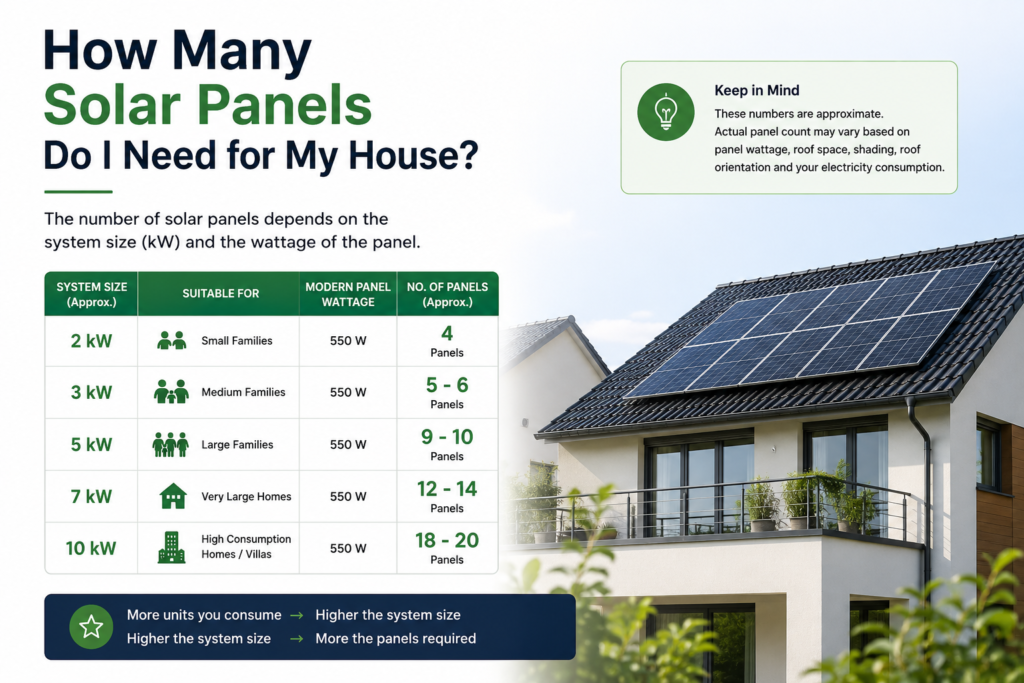
For many Bangalore homes, the requirement may fall somewhere around:
| Approx. Solar Capacity | Approx. Number of Modern Panels* |
|---|---|
| 2 kW | 4 panels |
| 3 kW | 5–6 panels |
| 5 kW | 9–10 panels |
| 7 kW | 12–14 panels |
| 10 kW | 18–20 panels |
*Indicative numbers based on modern higher-wattage modules. The exact number changes depending on the wattage of the panel selected and the final system design.
For example, ten 500 W panels create approximately a 5 kW array.
But simply deciding, “I need ten panels,” is not the best way to design your system.
First determine how much solar capacity your home actually needs.
Step 1: Look at Your Electricity Bill
Before going onto the terrace with a measuring tape, take out your electricity bills.
Ideally, look at the last 6–12 months rather than only the latest month.
Why?
Because electricity consumption changes throughout the year.
During hotter months you may use air conditioners more frequently. During holidays, travel or certain seasons your consumption may fall.
Your annual usage gives a much better picture.
For example, imagine your household consumption looks roughly like this:
- 250 units per month
- 400 units per month
- 600 units per month
- 900 units per month
Each household will require a different solar system.
This is why copying your neighbour’s system is usually a bad idea.
Your roof may look identical, but your electricity consumption may be completely different.
Don’t Start With Panel Count — Start With kW
Homeowners usually ask:
“How many panels do I need?”
Solar installers normally think first in terms of:
“How many kilowatts does this customer need?”
Once the required system capacity is determined, calculating the number of panels becomes straightforward.
The basic calculation is:
Required solar capacity ÷ individual panel wattage = approximate number of panels
For example:
If you are designing approximately 5 kW of solar and using 550 W modules:
5,000 W ÷ 550 W = approximately 9.1 panels.
The final engineering design would then determine the appropriate module count and actual installed DC capacity.
That is why panel wattage matters.
Ten older lower-wattage panels and ten modern high-wattage panels do not generate the same rated capacity.
How Many Panels Does a 3 kW Solar System Need?
A 3 kW rooftop solar system is popular among residential homeowners because it suits many moderate-consumption households.
With modern higher-wattage modules, you might use approximately 5–6 panels, depending on their rated capacity and the final system design.
However, don’t choose 3 kW simply because it is a common residential size.
The better question is:
Does 3 kW match my electricity consumption?
Your installer should study your bill, available roof area, sanctioned load, shading and future electricity requirements before recommending it.
Thinking about 3 kW solar?
Eltron Energy can calculate the appropriate system size from your actual electricity bill and rooftop.
Get a free rooftop solar assessment before choosing your system capacity.
How Many Panels Does a 5 kW Solar System Need?
A modern 5 kW rooftop solar system may require roughly 9–10 high-wattage panels, depending on the specific module used.
A 5 kW system is often considered by larger households with higher electricity consumption.
But again, the panel count is only one part of the decision.
Two important questions are:
Do you have enough shadow-free roof space?
and
Will you actually benefit from the electricity the system can generate?
Installing the largest possible system is not automatically the best financial decision.
A properly sized system usually gives better economics than simply filling every available part of your terrace with panels.
What If I Have a Very High Electricity Bill?
Suppose your house has:
- Multiple air conditioners
- Electric geysers
- Large refrigerators
- Water pumps
- Home office equipment
- EV charging
- A larger family
Your requirement could move beyond 5 kW.
Larger villas and high-consumption homes may consider 7 kW, 10 kW or even larger systems depending on sanctioned load, available rooftop area and electricity consumption.
This is where personalised system design becomes particularly important.
A generic online calculator cannot see the water tank casting a shadow over your roof at 4 PM.
A proper site survey can.
How Much Roof Space Do Solar Panels Need?
Your total terrace area and your usable solar area are not the same thing.
Imagine you have a large terrace.
It may still contain:
- Water tanks
- Staircase structures
- Parapet walls
- Satellite dishes
- Trees nearby
- Buildings casting shadows
- Clothes-drying areas
- Walking paths
- Plumbing lines
All of these affect where solar panels can actually be installed.
Modern high-efficiency panels can generate more power from a smaller roof area than older lower-wattage modules.
That is particularly useful for Bangalore homes where rooftop space is often limited.
Shading Can Change the Number of Panels You Need
This is one of the biggest reasons an onsite survey matters.
Imagine two identical houses.
Both have space for ten solar panels.
House A receives almost uninterrupted sunlight.
House B has a neighbouring building shading part of the terrace for several hours.
Putting the same ten-panel system on both roofs does not guarantee the same result.
Trees, water tanks, neighbouring buildings and rooftop structures can all affect generation.
A solar installer should therefore check not just:
“Can the panels physically fit?”
but:
“Will the panels receive sufficient sunlight where we put them?”
There is a major difference.
Panel Wattage Makes a Big Difference
Not all solar panels produce the same rated power.
For example, you may come across modules around:
- 450 W
- 500 W
- 540 W
- 550 W
- 575 W or higher
Panel technology continues to evolve.
Higher-wattage modules can reduce the number of individual panels needed to reach a particular system capacity.
This becomes valuable when roof space is limited.
But don’t choose a panel based only on the biggest wattage number printed on the datasheet.
Efficiency, manufacturer reputation, degradation, warranty, temperature performance and installation quality also matter.
The best system is not necessarily the one containing the panel with the largest number.
It is the one properly designed for your property.
monocrystalline vs polycrystalline solar panels
Should I Size Solar Based on My Current Bill or Future Usage?
This is an important question that many homeowners forget.
Imagine your electricity bill currently suggests that a 3 kW system is sufficient.
But next year you plan to:
- Buy an electric vehicle
- Install another air conditioner
- Add another floor to your house
- Convert to electric water heating
- Start working from home
- Add rental accommodation
Your electricity consumption could increase substantially.
Tell your solar installer about those plans before installation.
It may influence the system design, inverter selection and available rooftop layout.
Solar is a long-term investment.
Designing only around what your house consumes today can sometimes create unnecessary limitations later.
How Does the PM Surya Ghar Subsidy Affect System Size?
For eligible residential rooftop solar installations, the PM Surya Ghar: Muft Bijli Yojana provides Central Financial Assistance.
Under the current scheme structure, Central Financial Assistance applies to residential systems up to 3 kW, with no additional central CFA for capacity beyond 3 kW.
For qualifying residential installations, the maximum central subsidy can reach ₹78,000.
But there is an important point:
Don’t choose 3 kW only because of the subsidy.
Your solar plant should primarily be designed around your electricity requirement.
If your home genuinely needs 5 kW, installing only 3 kW could mean continuing to buy considerably more electricity from the grid simply because you wanted to maximise the subsidy proportion.
Think about the long-term economics, not only the initial discount.
What About BESCOM Net Metering?
If your property is within BESCOM territory and you are installing an on-grid rooftop solar system, the electrical and regulatory side of system sizing also matters.
The proposed solar capacity must comply with applicable connection and sanctioned-load requirements.
This is another reason system sizing should be completed professionally rather than simply ordering a certain number of solar panels online.
A complete rooftop solar project includes much more than panels:
- Solar modules
- Inverter
- Mounting structure
- Cables
- Protection equipment
- Earthing
- Metering
- System design
- Installation
- Testing
- Required approvals
The panel count is just the most visible part.
“My Neighbour Has 6 Panels. Should I Install 6 Too?”
Not necessarily.
Your neighbour may:
- Consume less electricity
- Have different panel wattage
- Have a different inverter
- Have better roof orientation
- Experience less shading
- Have different sanctioned load
- Have different future electricity requirements
Solar systems should be designed around the property and customer.
Think of it like buying shoes.
Knowing your neighbour’s shoe size doesn’t tell you yours.
A Simple Example
Imagine a Bangalore household consuming around 450–500 electricity units per month.
The owner calls a solar installer and says:
“I want five solar panels.”
That is backwards.
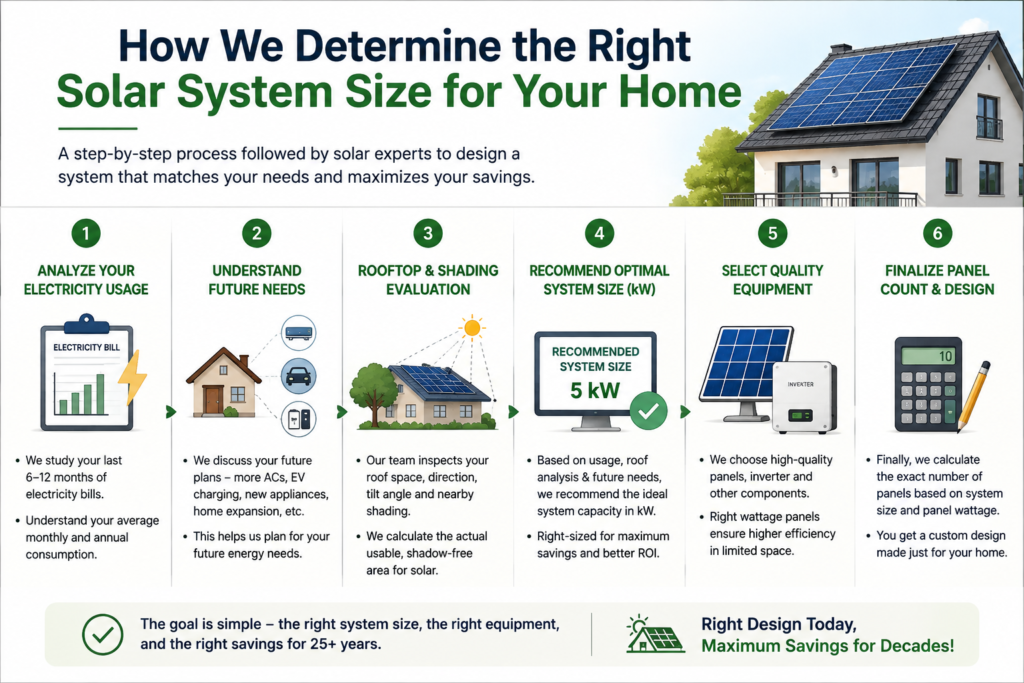
A better process would be:
1. Check electricity consumption
Study 6–12 months of bills.
2. Understand future load
Will consumption increase over the next few years?
3. Inspect the rooftop
Measure usable shadow-free area.
4. Select system capacity
Choose an appropriate kW size.
5. Select equipment
Determine suitable panels and inverter.
6. Calculate panel count
Only now decide exactly how many modules should be installed.
This method gives you a system designed around the outcome you actually want:
lower electricity bills.
Three Mistakes to Avoid When Choosing Your Solar Size
Mistake 1: Designing Solar Only From House Size
A 1,500 sq ft house does not automatically require a particular solar capacity.
Electricity consumption matters much more.
Mistake 2: Installing the Maximum Panels That Fit
More panels mean more investment.
The goal is not to win a competition for the most crowded terrace.
The goal is to build a financially sensible solar system.
Mistake 3: Choosing Only From Today’s Electricity Bill
If you are likely to add an EV or major electrical loads, mention that during system design.
So, How Many Solar Panels Does Your House Actually Need?
There isn’t one answer for every Bangalore home.
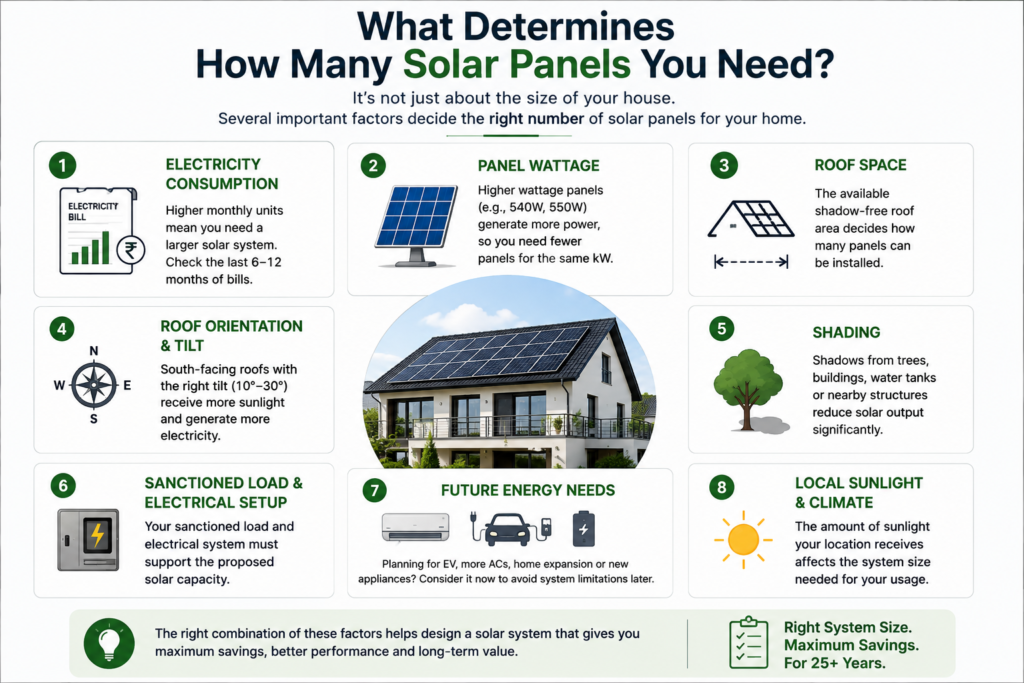
Your ideal system depends on:
1. Your electricity consumption
2. Panel wattage
3. Available shadow-free roof area
4. Sanctioned load
5. Roof orientation and shading
6. Your future electricity requirements
For one homeowner the correct answer may be 5–6 panels.
For another it may be 10.
For a large villa it could be 18 or more.
That is exactly why the most useful first step isn’t buying panels.
It is getting your home assessed.
Find Out Exactly How Many Solar Panels Your Home Needs
If you are considering rooftop solar in Bangalore or Karnataka, Eltron Energy can evaluate your electricity bill and rooftop before recommending a system.
A solar assessment can help determine:
- Recommended solar capacity
- Approximate number of panels
- Available usable roof area
- Expected solar generation
- Applicable residential subsidy
- Estimated installation cost
- Potential electricity savings
Don’t guess your solar system size.
Get a Free Rooftop Solar Assessment From Eltron Energy
View Eltron Energy on Google Maps & Read Customer Reviews →
A few minutes spent sizing the system correctly today can affect your electricity savings for the next two decades.
Author: Eltron Energy Solar Team