How Long Does Rooftop Solar Installation Take in Bangalore? Complete 2026 Timeline
If you have decided to install rooftop solar, one of the first practical questions you will probably ask is:
“How long will the whole thing take?”
Many homeowners imagine that installing solar means a team arrives in the morning, fixes panels on the roof and the house starts running on solar by evening.
The physical installation can actually be quite fast.
But a complete rooftop solar project involves much more than fixing panels to a roof.
There is the site survey, electricity consumption analysis, system design, equipment selection, approvals, installation, electrical work, inspection, net metering and commissioning.
So when someone says, “Solar installation takes two days,” they may only be talking about the physical installation.
For a homeowner in Bangalore, the more useful question is:
How long does it take from deciding to go solar until the system is fully commissioned and connected?
Here is what the complete journey usually looks like.
The Short Answer
For a straightforward residential rooftop solar project in Bangalore, the actual panel and electrical installation may take only a few days once everything is ready.
However, the complete process can take several weeks, particularly when DISCOM procedures, documentation, inspection and net metering are included.
The exact timeline depends on factors such as:
- Solar system size
- Roof condition
- Availability of equipment
- Complexity of the mounting structure
- Electrical modifications required
- Documentation
- BESCOM processing
- Net meter availability
- Whether you are applying under PM Surya Ghar
The important thing is to separate the installation time from the complete project timeline.
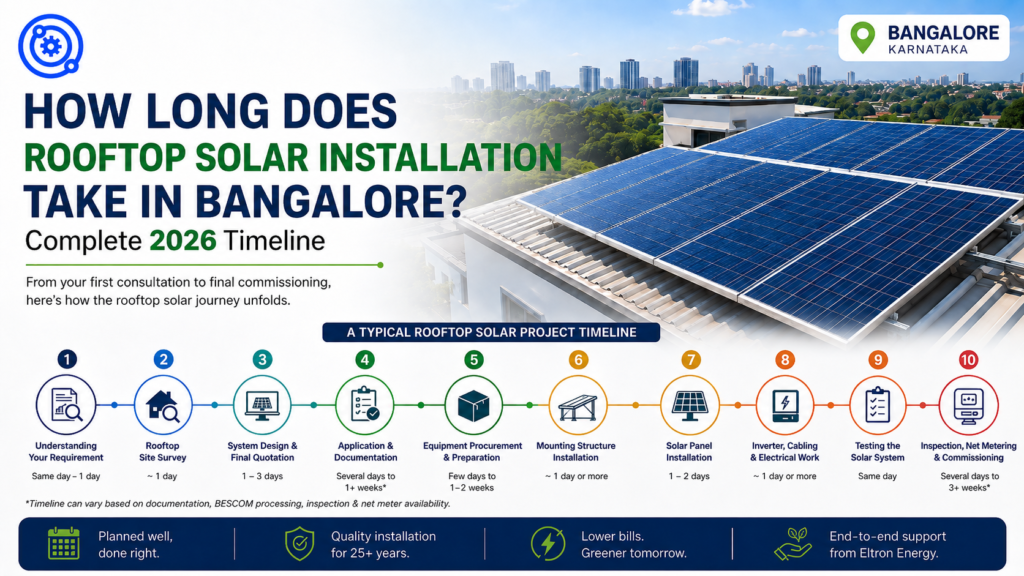
Stage 1: Understanding Your Electricity Requirement
Typical time: Same day to 1 day
A good rooftop solar project should begin with your electricity bill — not with a quotation.
Your installer should understand how much electricity your home actually consumes before suggesting a system size.
Usually, several months of electricity bills are reviewed to understand your consumption pattern.
The installer may also ask about future electricity requirements.
For example:
Are you planning to install another air conditioner?
Are you thinking about buying an electric vehicle?
Will you add an EV charger?
Are you expanding your house?
These changes can significantly affect how much electricity you consume in the future.
Someone currently suited for a 3 kW system could require a larger system once additional loads are added.
That is why sizing should happen before equipment is purchased.
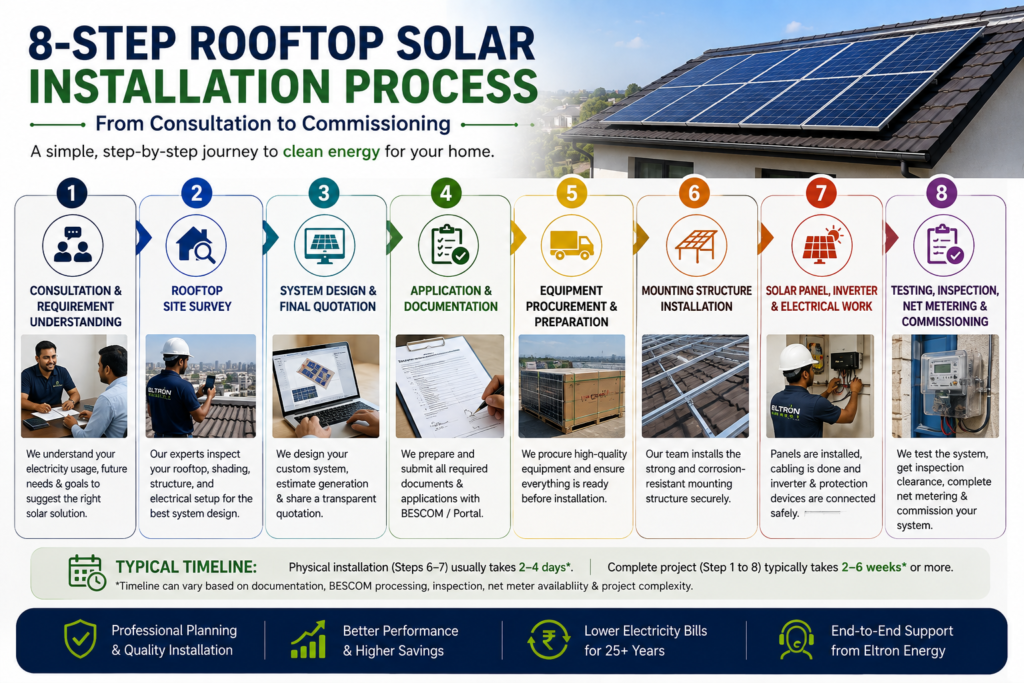
Stage 2: Rooftop Site Survey
Typical time: Around 1 day
The next step should be an actual rooftop inspection.
This is one of the most important parts of the installation process.
During a professional solar site survey, the installer should check:
Available rooftop area
Shadows from neighbouring buildings
Trees
Water tanks
Roof orientation
Roof condition
Possible panel arrangement
Cable routing
Location of the inverter
Earthing requirements
Existing electrical setup
A house may technically have enough roof area for ten panels but still have only enough usable shadow-free space for seven or eight.
That is why a quotation made entirely over the phone can be misleading.
A proper site survey allows the installer to design around the actual property.
Stage 3: Solar System Design and Final Quotation
Typical time: 1–3 days
After inspecting the site, the installer can prepare the final system design.
This is where questions such as these should be answered:
How many kW should be installed?
How many solar panels are required?
Where should the panels be placed?
What panel wattage will be used?
What inverter capacity is required?
Where should the inverter be installed?
What mounting structure is required?
How much electricity should the system reasonably generate?
This is also the right stage to finalize the quotation.
Do not compare quotations only by their final price.
Two 5 kW solar quotations can look similar while using very different panels, inverters, structures, protection devices, cables and warranties.
Understanding exactly what is included before paying an advance can prevent expensive surprises later.
Stage 4: Application and Documentation
This is where the timeline starts becoming less predictable.
For residential customers using the PM Surya Ghar Muft Bijli Yojana, the process involves the national rooftop solar framework and the relevant electricity distribution company.
Government reforms have simplified rooftop solar procedures, including provisions relating to systems up to 10 kW and reduced commissioning timelines for DISCOMs. However, the actual time taken on an individual project can still vary depending on documentation, local processing and site-specific requirements.
This is one reason choosing an installer that understands the documentation process matters.
Missing documents, incorrect consumer details or mismatched information can delay an otherwise simple installation.
Stage 5: Equipment Procurement and Preparation
Typical time: A few days to around 1–2 weeks
Once the design is finalized, the required equipment must be arranged.
This may include:
Solar modules
Solar inverter
Mounting structure
DC cables
AC cables
ACDB/DCDB or required protection equipment
Earthing materials
Lightning protection where applicable
Connectors
Conduits
Monitoring equipment
The timeline depends heavily on whether the selected equipment is already available.
Standard residential systems using readily available components can move quickly.
A customized structure, special roof condition or specific equipment requirement may take longer.
This is another reason it is better to design first and buy second.
Stage 6: Mounting Structure Installation
Typical time: Around 1 day or more depending on the roof
Before the panels can be installed, the mounting structure has to be prepared and securely fixed.
On a simple residential terrace, this can be relatively straightforward.
More complicated roofs may require additional work.
The structure is extremely important because the solar modules may remain on your roof for decades.
A poorly designed structure can lead to alignment problems, instability and unnecessary maintenance later.
Saving a few hours during installation is not worth compromising structural quality.
Stage 7: Solar Panel Installation
Typical time: Around 1–2 days for many residential projects
This is the part most people think of when they hear “solar installation.”
The installation team positions the panels according to the approved layout and secures them to the mounting structure.
Panels are then electrically connected.
For a relatively straightforward 3 kW or 5 kW residential rooftop, this stage can often move quickly once the structure, equipment and electrical plan are ready.
Larger houses, villas and commercial projects naturally require more time.
Stage 8: Inverter, Cabling and Electrical Work
Typical time: Around 1 day or more
Solar panels are only one part of the system.
The electricity generated by the panels must safely reach the inverter and then integrate with your home’s electrical system.
This stage can involve:
DC cabling
AC cabling
Inverter installation
Earthing
Isolation devices
Protection equipment
Distribution board connections
System monitoring setup
Grid interconnection preparation
This work should not be rushed.
Solar is an electrical power plant installed on your property, even if it is a small one.
Safe wiring, correct protection devices and professional workmanship matter far more than finishing a few hours earlier.
Stage 9: Testing the Solar System
Before commissioning, the installer should test the complete system.
The team should verify that the panels, inverter, electrical protection and monitoring system are functioning correctly.
The installation should also be checked against the approved system design.
This is the stage where small installation issues should be found — not six months later when the homeowner notices that the system is producing less electricity than expected.
Stage 10: Inspection, Net Metering and Commissioning
For an on-grid rooftop solar system, completing the physical installation does not necessarily mean the project is finished.
The system must be properly integrated with the electricity distribution network.
In Bangalore, BESCOM-related net metering and commissioning procedures can contribute significantly to the overall project timeline. Eltron Energy’s existing Bangalore net-metering guide notes that real-world residential processing can take several weeks depending on approvals and meter availability.
The broader rooftop-solar framework has been designed to make grid connection faster, including a reduced DISCOM commissioning timeline, but actual turnaround can still vary locally.
This explains why two neighbours installing similar 3 kW systems may not receive final commissioning on exactly the same day.
So, How Long Should You Plan For?
Think about rooftop solar in two timelines.
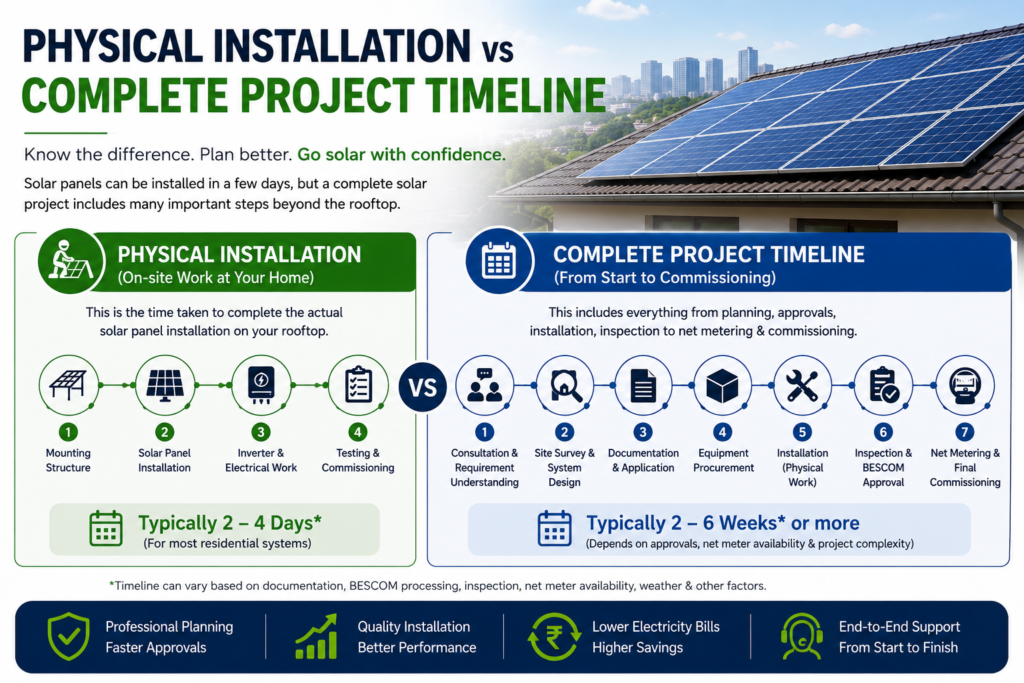
Physical Installation
For a normal residential property with a prepared roof, finalized design and equipment ready, the actual on-site installation can often be completed within a few days.
Complete Solar Project
From the first consultation through design, documentation, installation, inspection, net metering and final commissioning, it is safer to plan for several weeks rather than several days.
A well-coordinated project can move faster.
A project involving documentation problems, equipment delays, roof modifications or DISCOM delays may take longer.
That is why homeowners should ask an installer:
“When you say installation takes three days, do you mean only the physical installation, or do you mean until my solar system is commissioned?”
That one question can prevent a lot of confusion.
What Can Delay a Rooftop Solar Installation?
Most delays are not caused by fixing solar panels.
They usually happen before or after that stage.
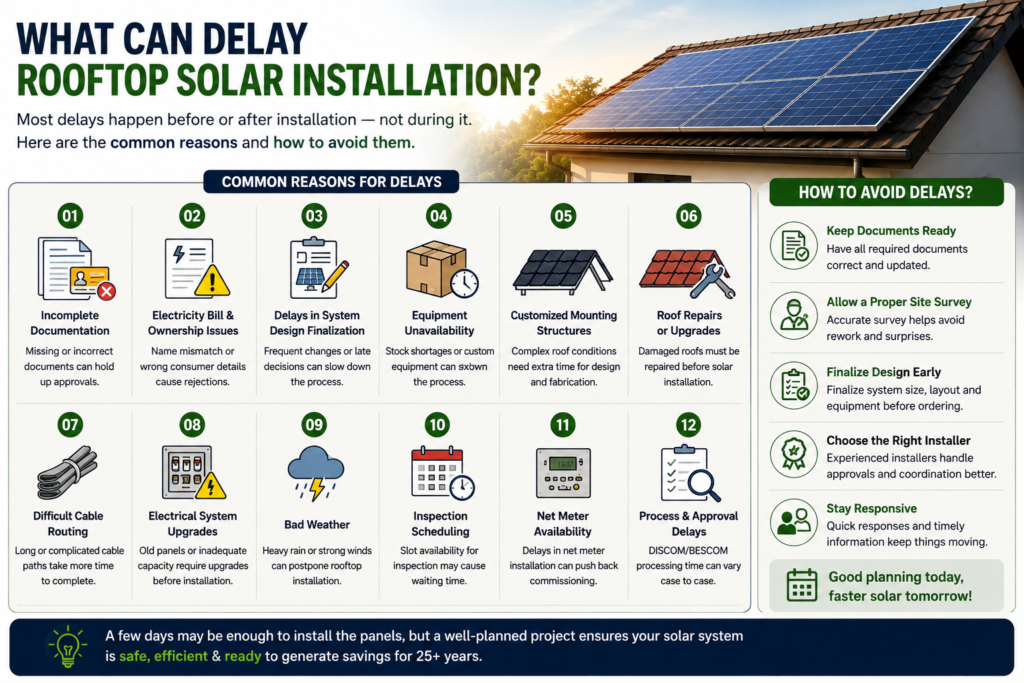
Common reasons include incomplete documentation, electricity-bill ownership issues, delays finalizing the system design, unavailable equipment, customized mounting structures, roof repairs, difficult cable routes, electrical upgrades, bad weather, inspection scheduling and net-meter availability.
A professional installer should identify many of these potential delays before the project begins.
Can You Make the Installation Process Faster?
Yes.
One of the simplest things homeowners can do is prepare everything before the installation starts.
Keep your latest electricity bills and required identification/property documentation ready.
Make sure the electricity connection details are correct.
Allow the installer to conduct a proper site survey.
Finalize the system size before purchasing equipment.
Ask for equipment brands and specifications in writing.
Understand who will handle the net-metering and commissioning process.
And most importantly, avoid making major system changes halfway through the project.
Changing from a 3 kW system to a 5 kW system after equipment has been ordered can affect the design, inverter, structure, panel quantity and documentation.
Planning properly at the beginning is almost always faster than correcting mistakes later.
Don’t Choose a Solar Installer Just Because They Promise the Fastest Installation
“Installation tomorrow.”
It sounds attractive.
But speed alone does not make a good solar installation.
Your rooftop solar system may operate for 20–25 years or longer.
Taking an extra day to correctly assess the rooftop, design the system and complete electrical work is far better than spending years dealing with poor performance.
What matters is not simply:
“How fast can you install solar?”
The better question is:
“How efficiently can you design, install, approve and commission the system without compromising quality?”
Planning Rooftop Solar in Bangalore?
If you are considering rooftop solar for your home, villa, apartment, commercial property or industrial building, start with the right information.
Eltron Energy provides rooftop solar solutions across Bengaluru and Karnataka, covering the journey from system planning and rooftop assessment through installation and commissioning support.
Instead of guessing your solar requirement, start with your electricity bill and rooftop.
Get a Free Solar Site Survey
Share your electricity consumption and project requirements with the Eltron Energy team.
We can help you understand:
- The right system capacity for your property
- Approximate number of solar panels required
- Suitable rooftop layout
- Equipment options
- Expected generation
- Applicable residential subsidy considerations
- Installation requirements
- Net-metering process
A few days may be enough to install the panels.
A properly planned solar project is about getting the next 25 years right.
Frequently Asked Questions
How many days does it take to install solar panels on a house?
Once the system design, equipment and site are ready, the physical installation of a typical residential rooftop system may be completed within a few days. The complete project, including documentation, approvals, inspection and grid commissioning, can take considerably longer.
How long does a 3 kW solar installation take?
A straightforward 3 kW rooftop system is relatively quick to physically install. However, the complete timeline depends on site preparation, equipment availability, documentation and DISCOM/net-metering procedures.
How long does a 5 kW solar installation take in Bangalore?
The physical installation of a typical residential 5 kW system can usually be completed relatively quickly once the design and materials are finalized. Allow additional time for applications, inspection and commissioning.
Can rooftop solar be installed in one day?
Some small and straightforward installations may have significant physical work completed within a day, but a complete grid-connected solar project normally involves several additional stages.
Does BESCOM approval take longer than solar installation?
It can. The physical work on the rooftop may take only a few days, while documentation, inspection, net metering and commissioning can extend the overall project timeline.
Should I apply for PM Surya Ghar before installing solar?
Residential customers planning to claim benefits under PM Surya Ghar should follow the applicable portal and DISCOM process and use compliant equipment/vendor procedures rather than installing first and trying to correct the paperwork afterwards.
Author: Eltron Energy Editorial Team
Updated: August 31, 2026