What I Wish I Knew Before Installing Solar Panels: 12 Things Bangalore Homeowners Should Know
Most solar regrets don’t begin after the panels are installed.
They begin before installation.
Someone chooses a system because their neighbour installed the same capacity.
Someone accepts the cheapest quotation without checking the inverter.
Someone assumes installing solar means the house will have power during every electricity cut.
Someone plans around a government subsidy without first understanding the eligibility process.
And sometimes, a homeowner discovers only after installation that the water tank shades three panels every afternoon.
None of these problems mean solar was a bad decision.
They usually mean there were a few things the homeowner would have benefited from knowing earlier.
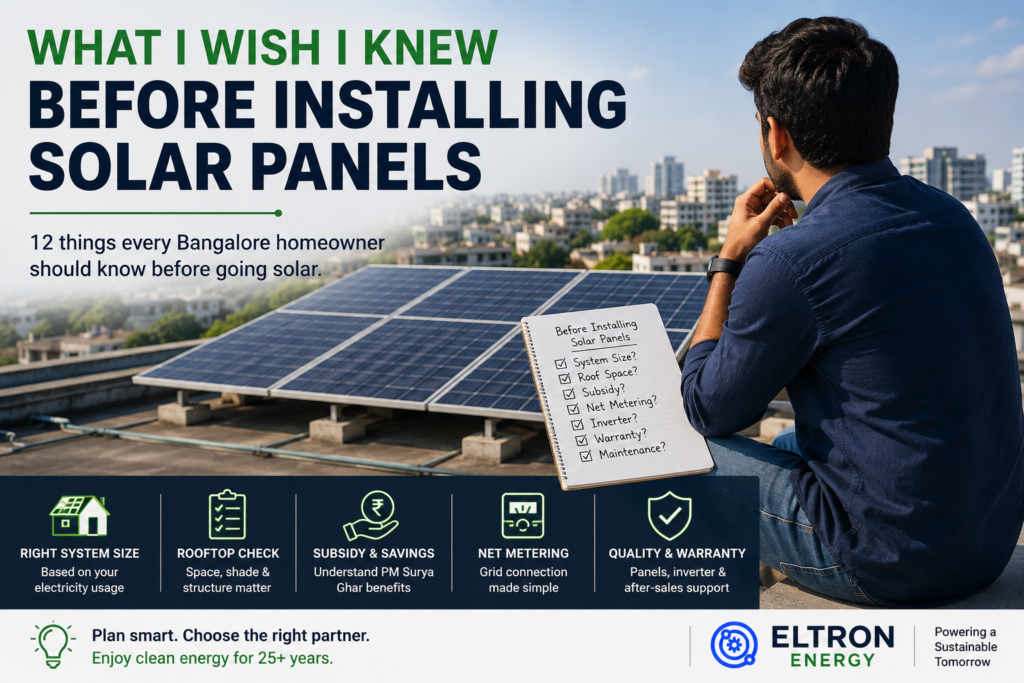
So if you’re considering solar panel installation in Bangalore, here are 12 things worth understanding before anyone starts drilling, mounting or wiring anything on your rooftop.
1. I Wish I Knew That My Electricity Bill Matters More Than the Size of My House
One of the first questions homeowners ask is:
“My house is 1,500 sq ft. What size solar system do I need?”
But your house size doesn’t tell us how much electricity you use.
Consider two identical houses.
House A has two occupants, one refrigerator and moderate appliance usage.
House B has five occupants, three air conditioners, electric water heating, a water pump and an EV charger.
The roofs may be identical.
Their electricity requirements certainly aren’t.
A better starting point is your electricity consumption over the previous 6–12 months.
Look at how many units you use, not simply how much you paid.
Your installer can then combine that consumption with rooftop space, shading, sanctioned load and other factors to recommend an appropriate system.
That’s why choosing between 3 kW, 5 kW or 10 kW shouldn’t begin with a guess.
Start with the bill. Then design the system.
Eltron’s own sizing guide also recommends looking at longer-term consumption rather than choosing a panel count based simply on house size.
how many solar panels your home needs
2. I Wish I Knew That “Available Roof Space” and “Usable Roof Space” Are Different
Walk onto a large terrace and it is easy to think:
“There is plenty of space for solar.”
But your entire terrace cannot necessarily be covered with panels.
Your rooftop may contain:
- Water tanks
- Staircase rooms
- Parapet walls
- Satellite dishes
- Plumbing lines
- Clothes-drying areas
- Walkways
- Trees nearby
- Adjacent buildings
Then there is shading.
A water tank that looks harmless at noon may cast a large shadow later in the afternoon.
A neighbouring building may affect only one section of the roof.
That is why a physical rooftop survey is valuable before the equipment is finalized.
The real question isn’t:
“Can we fit the panels?”
It is:
“Can we place the panels where they can generate effectively for years?”
3. I Wish I Knew That Bigger Isn’t Automatically Better
It is tempting to think:
More solar panels = better solar system.
Not always.
If your consumption requires approximately 3 kW, installing a much larger system simply because your roof can accommodate it may not automatically provide the best financial outcome.
The objective is to design around:
Your consumption + your roof + your electrical connection + your future needs.
There is one exception worth thinking about: future electricity demand.
If you’re planning to buy an EV, add another floor, install more ACs or move additional appliances to electricity, tell your installer now.
A solar system could remain on your property for decades.
Designing only around today’s electricity consumption without discussing tomorrow’s needs can create unnecessary limitations later.
3 kW solar system in Bangalore
4. I Wish I Knew That Solar Panels Are Only One Part of the System
Solar marketing naturally focuses heavily on panels.
They are large, visible and easy to understand.
But your rooftop system also needs other components working together.
Depending on the system, that can include:
- Solar inverter
- Mounting structure
- DC cables
- AC cables
- Connectors
- AC and DC protection
- Earthing
- Surge protection
- Distribution equipment
- Net meter
- Monitoring system
This is why comparing two quotations only by asking:
“Which panel brand are you giving?”
isn’t enough.
An excellent solar panel combined with poor cabling, weak mounting, incorrect protection or a badly selected inverter can still result in a poor solar installation.
Think about the entire system, not just the panels.
5. I Wish I Knew How Important the Inverter Is
Homeowners frequently spend twenty minutes discussing the panel manufacturer and two minutes discussing the inverter.
It should receive much more attention.
Solar panels generate DC electricity.
The inverter converts that electricity into AC power that can be used by your home.
Before signing a quotation, ask:
What inverter brand and model are you installing?
What capacity is it?
What warranty does it have?
Can I monitor generation through an app?
Who handles warranty support if it fails?
If your rooftop has unusual shading or you have specific backup requirements, inverter selection becomes even more important.
A solar system is a team.
The panels shouldn’t be the only player you investigate.
6. I Wish I Knew That On-Grid Solar Doesn’t Automatically Give Backup During a Power Cut
This surprises many first-time solar buyers.
You see solar panels on your roof.
The sun is shining.
Then BESCOM power goes off.
And your house may still lose electricity.
Why?
Standard on-grid solar systems are designed to disconnect during a grid outage for safety, rather than continuing to feed electricity into a grid that technicians may be repairing.
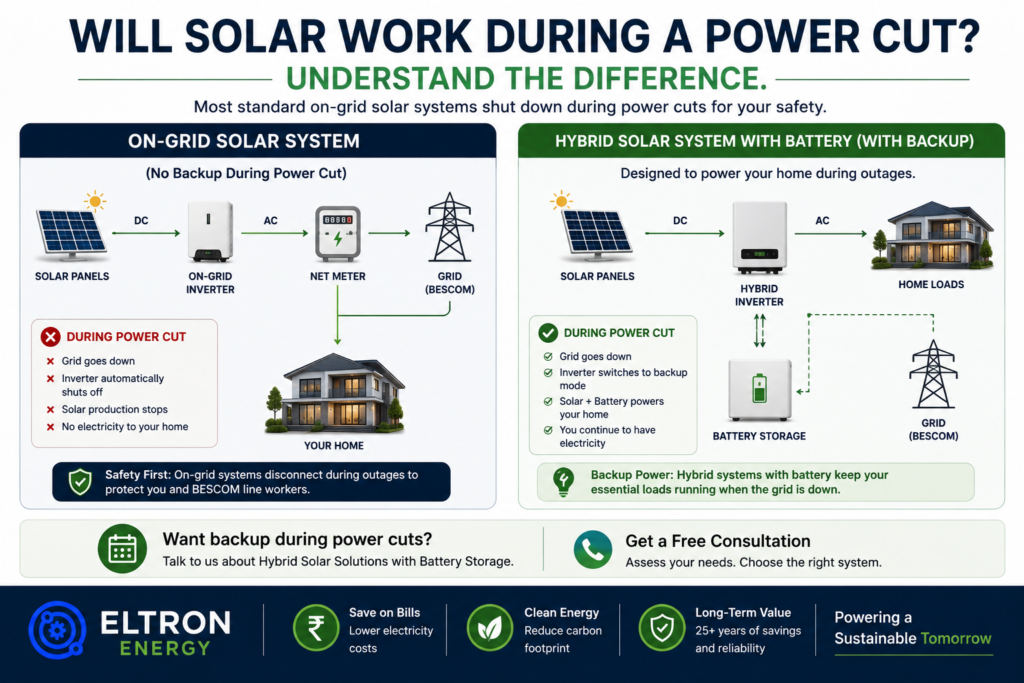
If backup during power cuts is important to you, discuss that requirement before selecting the system architecture.
You may need to evaluate options such as a hybrid solar system and suitable battery storage rather than assuming every rooftop solar installation behaves like a backup power system.
This one conversation can prevent a major misunderstanding after installation.
7. I Wish I Understood the PM Surya Ghar Subsidy Before Choosing the System
The PM Surya Ghar: Muft Bijli Yojana has made residential rooftop solar significantly more attractive for eligible households.
Under the current central structure, the residential CFA is ₹30,000 per kW for the first 2 kW and ₹18,000 for the additional capacity up to 3 kW, meaning eligible installations of 3 kW or above can receive up to ₹78,000 in central assistance.
But here’s what homeowners should understand:
Subsidy is not simply “buy solar and collect ₹78,000.”
There are scheme procedures, technical requirements, vendor requirements and DISCOM verification involved. MNRE’s current rooftop programme information specifically ties the residential assistance process to successful installation and DISCOM verification.
So don’t finalize equipment first and investigate subsidy eligibility afterwards.
Discuss it before you sign.
And don’t choose an undersized system purely because of the subsidy.
The system still needs to make financial sense for your actual electricity consumption.
Get a Free Solar Site Survey & Quote
8. I Wish I Knew That Net Metering Is Part of the Project
For an on-grid rooftop solar installation in Bangalore, installing the panels is not the entire journey.
There is also the grid-connection and BESCOM net-metering process.
Depending on the project and applicable requirements, this can involve documentation, technical details, approval, inspection/verification, meter-related work and commissioning.
This is something to clarify with your solar company before installation.
Ask:
Who submits the application?
Who prepares the documents?
Who coordinates with BESCOM?
Who follows up until commissioning?
You don’t want to discover after the panels are installed that the company considered its work finished the moment the inverter was switched on.
Eltron already has a detailed Bangalore guide explaining the BESCOM net-metering process and common issues.
9. I Wish I Knew That the Cheapest Quotation Isn’t Always the Cheapest Solar System
Imagine you receive these two quotations.
Quotation A: ₹20,000 cheaper.
Quotation B: Better mounting structure, clearly specified inverter, proper electrical protection, documented warranties and post-installation support.
Which is cheaper?
On installation day, probably A.
Five or ten years later?
That is a different question.
Solar should be evaluated as a long-term energy asset, not as a one-day purchase.
When comparing quotations, check what you’re actually receiving.
Ask for the exact:
- Panel manufacturer and model
- Panel wattage
- Inverter manufacturer and model
- Mounting structure specification
- Electrical protection
- Earthing scope
- Monitoring system
- Workmanship warranty
- Product warranties
- Documentation scope
- Net-metering assistance
- After-sales support
If one quotation is significantly cheaper than all the others, don’t immediately celebrate.
Find out why.
10. I Wish I Knew My Electricity Bill Might Not Literally Become Zero
“Install solar and get zero electricity bills.”
It’s an attractive line.
It isn’t a useful promise to base your investment on.
Your actual post-solar electricity bill can depend on your system generation, electricity consumption, when you consume electricity, applicable tariff structure, grid import/export and fixed or other applicable charges.
There are also seasonal changes.
A solar system won’t produce exactly the same amount every day of every month.
Cloud cover, rainfall, temperature, shading and panel cleanliness can all affect production.
So instead of asking an installer:
“Will my bill become zero?”
ask:
“What annual generation do you estimate for this system, and approximately how does that compare with my annual consumption?”
That’s a much better question.
11. I Wish I Knew That Solar Is Low-Maintenance, Not No-Maintenance
Once installed properly, rooftop solar doesn’t require someone standing on your roof every week.
But it shouldn’t simply be forgotten for 25 years either.
Bangalore rooftops accumulate:
- Dust
- Pollution
- Leaves
- Bird droppings
- Other debris
Dirty panels can reduce the amount of sunlight reaching the cells.
Over time, it is also sensible to keep an eye on:
- System generation
- Inverter alerts
- Electrical connections
- Cable condition
- Mounting hardware
- Earthing and protection
- Physical panel condition
One of the easiest habits is simply checking your solar monitoring application regularly.
If generation suddenly falls without an obvious weather-related reason, investigate it.
A small issue found early can be much easier to solve than one ignored for months.
12. I Wish I Had Asked More About After-Sales Support
This may be the most important lesson in the entire article.
Before paying your advance, ask:
“If my system has a problem three years from now, who exactly do I call?”
You should get a clear answer.
Not:
“Don’t worry, sir. We’ll take care of everything.”
A real answer.
Who handles the complaint?
What is covered?
What isn’t?
Who coordinates inverter warranty claims?
Who checks unexpectedly low generation?
What happens if a component needs replacement?
How do you raise a service request?
Solar warranties can extend for many years, but warranties are useful only when there is a practical way to use them.
This is why choosing the installer matters almost as much as choosing the equipment.
One More Thing: Don’t Buy the Panels Before the System Is Designed
This deserves its own section because it prevents several of the mistakes above.
The correct order should normally look more like this:
1. Review electricity consumption
↓
2. Conduct rooftop assessment
↓
3. Check shading and usable area
↓
4. Determine appropriate system capacity
↓
5. Understand subsidy and grid requirements
↓
6. Select compatible panels, inverter and components
↓
7. Finalize quotation
↓
8. Install, test and commission
Not:
Buy panels → Find someone to make them fit.
We recently covered this issue in detail because rooftop solar includes design, electrical work, mounting, protection, approvals and commissioning—not simply attaching panels to a roof.
professional solar installation
A Simple Pre-Solar Checklist for Bangalore Homeowners
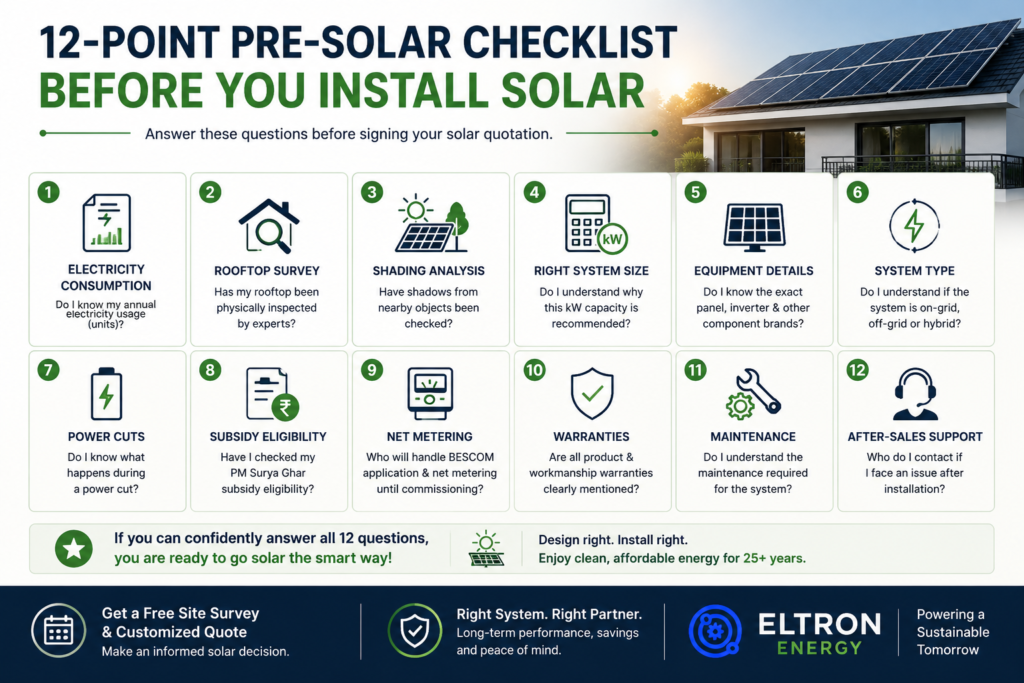
Before signing your solar quotation, make sure you can answer all of these:
Do I know my annual electricity consumption?
Has someone physically inspected my rooftop?
Have shadows been considered?
Do I understand why this particular kW capacity was recommended?
Do I know the exact panel and inverter models?
Do I understand whether this is on-grid, off-grid or hybrid?
Do I understand what happens during a power cut?
Have I confirmed my applicable PM Surya Ghar eligibility?
Do I know who manages BESCOM/net-metering work?
Are all warranties written in the quotation?
Do I understand what maintenance is required?
Do I know whom to contact after installation?
If you can confidently answer all twelve, you’re already approaching your solar decision much better than someone choosing purely on price.
Planning Rooftop Solar in Bangalore?
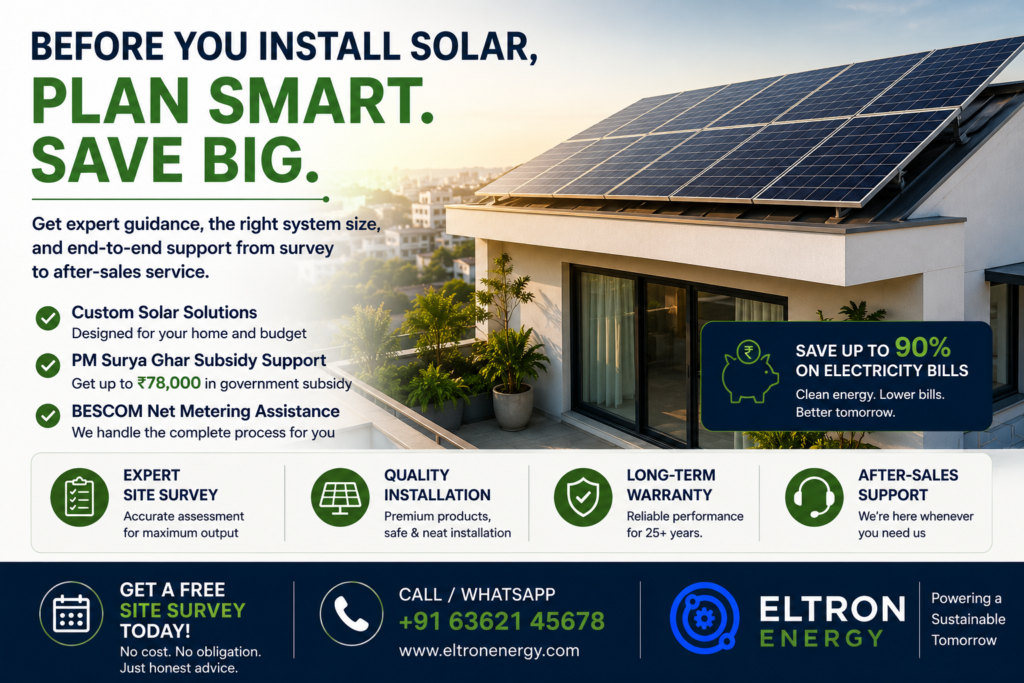
Going solar should reduce your electricity expenses and make energy costs more predictable for years.
It shouldn’t create a new list of problems to solve.
The best way to avoid surprises is to design the project properly before buying equipment.
Eltron Energy provides rooftop solar solutions for residential, commercial and industrial properties in Bangalore and across Karnataka.
A professional assessment can evaluate your electricity consumption, available rooftop area, shading, electrical requirements and suitable system capacity before the final quotation is prepared.
Before you buy panels, understand your roof. Before you choose the system, understand your bill. And before you choose an installer, understand exactly what you’re paying for.
Planning to install rooftop solar? Talk to Eltron Energy for a site survey and customized solar quotation.
By Eltron Energy Editorial Team