Can I Just Buy Solar Panels and Hire an Electrician?
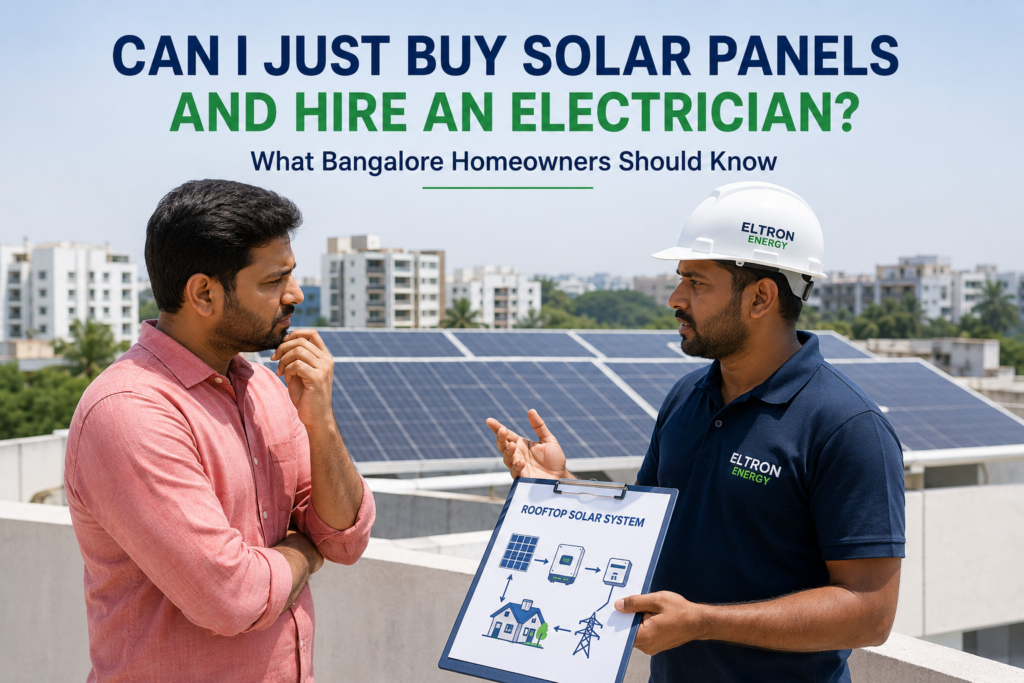
Buying solar panels online has become surprisingly easy.
Search for a 540W or 550W solar panel, and within minutes you can compare different brands, specifications and prices. That naturally leads many homeowners to one question:
“Why can’t I simply buy the panels myself and hire a local electrician to install them?”
At first, the idea sounds practical.
You buy the equipment directly, pay someone for installation and potentially save the margin charged by a professional solar company.
But a rooftop solar system is not simply a collection of panels connected to your home’s electrical wiring.
The panels are only one part of the system.
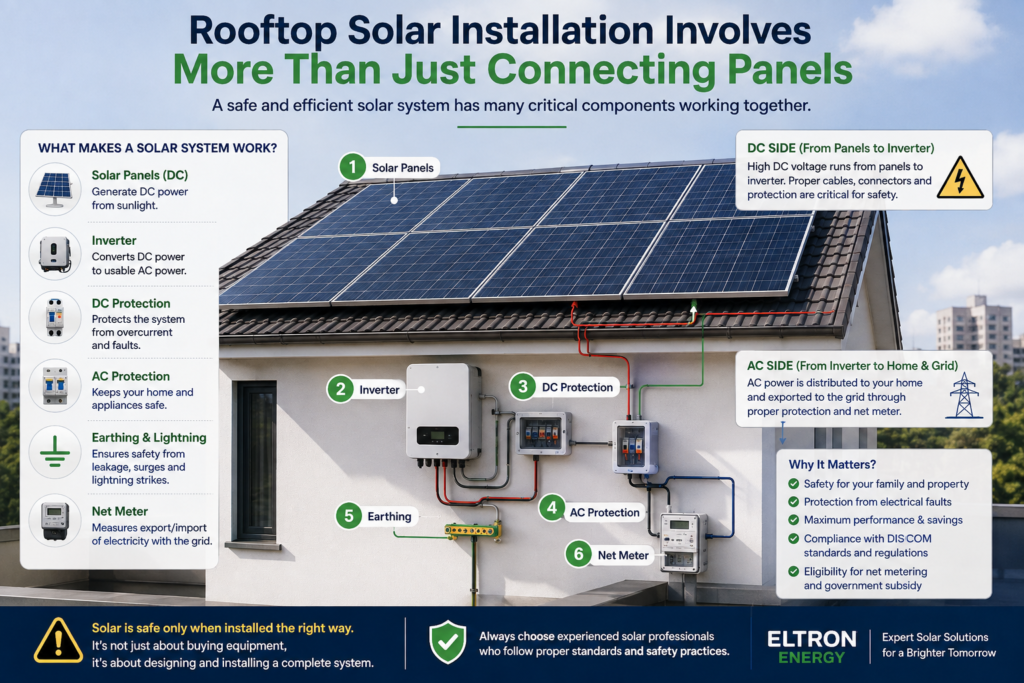
System sizing, rooftop design, shading, mounting structure, inverter selection, DC protection, AC protection, earthing, net metering, documentation, commissioning, monitoring and long-term support all affect how safely and efficiently your solar plant performs.
So, can an electrician install solar panels?
Technically, an electrician may be able to handle certain electrical parts of the installation.
But should you build an entire grid-connected rooftop solar project this way?
For most homeowners, the answer deserves much more thought.
Solar Installation Is More Than Electrical Wiring
When people think about solar installation, they often imagine this process:
Buy panels → Put them on the roof → Connect an inverter → Start generating electricity.
A properly designed rooftop solar system has considerably more going on behind the scenes.
Before the first panel reaches your roof, someone needs to determine:
- How much electricity your household actually consumes
- What solar system capacity is appropriate
- Whether your roof has sufficient usable space
- Where shadows fall during the day
- Which panel wattage suits the available area
- What inverter capacity is required
- How the mounting structure should be designed
- Where the cables will run
- How the system will be earthed and protected
- How the solar plant will connect with your existing electrical system
- What approvals and net-metering procedures apply
Skipping these decisions can result in a system that works — but doesn’t necessarily work well.
And with solar expected to remain on your property for many years, “it works” should not be the standard.
The goal should be safe, reliable and consistent generation.
Problem #1: Who Will Decide the Correct System Size?
Suppose your electricity bill suggests that a 5 kW solar system might suit your home.
Does that automatically mean you should buy enough panels to make exactly 5 kW?
Not necessarily.
Your system size should consider your actual electricity consumption, available rooftop area, shading, sanctioned electrical load and expected future requirements.
For example, your electricity demand could increase if you plan to add:
- Another air conditioner
- An electric vehicle
- A water heater
- Additional floors or rooms
- More electrical appliances
At the same time, your rooftop may not have enough shadow-free space for the system you initially wanted.
A professional site survey connects these two sides of the project:
How much electricity you need and how much solar your roof can realistically support.
Without that assessment, you may end up buying equipment before knowing whether it actually suits your property.
Problem #2: Buying Panels Is Only the Beginning
Solar panels may be the most visible component, but they aren’t the entire system.
A typical rooftop solar installation can also involve:
- Solar inverter
- Module mounting structure
- DC cables
- AC cables
- DC protection
- AC protection
- Earthing system
- Lightning and surge protection as applicable
- Connectors
- Distribution boxes
- Monitoring equipment
- Fasteners and structural hardware
The equipment must also work together correctly.
Buying an excellent solar panel doesn’t automatically create an excellent solar system.
Think of it like building a high-performance computer.
Buying an expensive processor doesn’t help if the power supply, cooling, motherboard and other components are poorly matched.
Solar works the same way.
The complete system matters more than any single component.
Problem #3: Rooftop Solar Has a DC Side and an AC Side
A household electrician generally works extensively with AC electrical systems.
Solar introduces an important additional element: DC electricity generated by the panels.
The panels produce DC power whenever sufficient light reaches them. That electricity travels through the solar-side wiring to the inverter, where it is converted into AC electricity that your property can use.
This means cable selection, connectors, protection devices, isolation, earthing and installation practices matter.
Incorrect connections or poorly installed components aren’t simply an efficiency problem.
They can become a safety problem.
Solar installation therefore needs someone who understands the complete solar power system — not only conventional home wiring.
Problem #4: Who Will Design the Mounting Structure?
Your electrician may be excellent at electrical work.
But who is designing the structure holding the panels?
The mounting structure has to keep the solar array securely positioned on the rooftop through years of sun, rain and wind.
The design may depend on:
- Roof type
- Available space
- Panel dimensions
- Required tilt
- Building height
- Local site conditions
- Obstacles on the terrace
- Water tanks
- Parapet walls
- Maintenance access
- Desired panel orientation
This is particularly important because the structure affects both safety and solar generation.
Poor placement can create unnecessary shading.
Poor structural work can create long-term durability problems.
And bad cable routing can make an otherwise good installation look unfinished.
A rooftop solar system should be designed as one project rather than panels, structure and electrical work being handled independently without coordination.
Problem #5: What Happens When There Is Shading?
Imagine you buy ten panels because your calculation says ten panels will provide the capacity you need.
Then installation day arrives.
The installer discovers that a water tank shades part of the planned solar array during the afternoon.
Now what?
This is precisely why a rooftop assessment should happen before buying the equipment.
Trees, neighboring buildings, parapet walls, water tanks and other rooftop structures can affect how much usable solar area you actually have.
Even if the total terrace area looks large, the usable shadow-free area can be much smaller.
A solar company can plan panel placement around these conditions before equipment is finalized.
Problem #6: Who Handles Net Metering and Grid Connection?
For an on-grid rooftop solar system in Bangalore, installation isn’t necessarily finished when the inverter switches on.
The project also needs to fit into the applicable electricity-distribution and net-metering process.
That can involve documentation, application procedures, technical requirements, inspection or verification and coordination with the relevant electricity distribution company.
For Bangalore homeowners, this commonly means dealing with the BESCOM process applicable to the property.
If you are buying equipment yourself, establish beforehand:
Who is responsible for this paperwork?
Don’t assume your electrician automatically handles it.
Ask before buying anything.
A cheaper installation becomes much less attractive if you later discover that nobody involved in the project is taking responsibility for getting the grid-connected system properly commissioned.
Problem #7: What Happens to Your PM Surya Ghar Subsidy?
This is particularly important for residential homeowners planning to use the PM Surya Ghar Muft Bijli Yojana.
Government-supported rooftop solar isn’t simply:
Buy any panels → Hire anyone → Claim the subsidy.
The scheme operates through defined procedures, technical requirements, vendors and DISCOM verification.
If receiving the applicable subsidy is part of your financial calculation, confirm the eligibility and process before purchasing your solar equipment.
Otherwise, trying to save money by independently buying panels could complicate the project.
The correct question isn’t only:
“How cheaply can I buy these panels?”
It is:
“Will this complete installation satisfy the requirements for the system and scheme I want to use?”
Problem #8: Who Is Responsible When Something Goes Wrong?
This is one of the biggest differences between buying components separately and getting a complete rooftop solar installation.
Imagine that six months after installation, your solar generation suddenly drops.
You call the panel supplier.
They say the panels are fine.
You call the inverter manufacturer.
They say the inverter appears normal.
You call the electrician.
They say the electrical connections are fine.
You call the person who fabricated the structure.
They tell you the structure has nothing to do with generation.
So who diagnoses the actual problem?
When multiple parties supply and install different parts of the system, responsibility can become unclear.
With an end-to-end solar installer, you have one primary company responsible for understanding the complete installation.
That can make after-sales service considerably easier.
Problem #9: Your Warranty May Not Cover Installation Mistakes
A long solar panel warranty sounds reassuring.
But the panel warranty doesn’t necessarily protect you against every problem that can happen on your rooftop.
Different components can have different warranties.
There may be separate warranties for:
- Solar panels
- Panel performance
- Inverter
- Other equipment
- Installation workmanship
That means a component can be perfectly functional while the overall installation still has a problem.
For example, poor cable management or an installation-related issue isn’t automatically the panel manufacturer’s responsibility.
Before choosing the DIY purchasing route, ask yourself:
Who is providing a warranty on the actual installation work?
Get that answer in writing.
But Isn’t Buying Everything Myself Cheaper?
Sometimes the upfront number may look cheaper.
And for someone with strong solar engineering knowledge, project-management experience and access to qualified professionals, independently managing a solar project may be possible.
But homeowners should compare the complete project cost, not merely the price of the solar panels.
Consider what is included in both options.
Self-managed approach
You may need to separately arrange:
Panel purchase
Inverter purchase
Mounting structure
Transport
Electrical materials
Structural fabrication
Electrical labour
Solar-specific labour
Site survey
Design
Approvals and documentation
Net-metering assistance
Commissioning
Monitoring
Maintenance
Troubleshooting
Professional solar installer
A complete EPC-style rooftop solar provider can combine many or all of these responsibilities into one project.
So instead of comparing:
Panel price vs solar company quotation
compare:
Total completed self-managed project vs total professionally installed project.
That’s a much fairer comparison.
When Does Hiring Your Own Electrician Make Sense?
There are situations where working with your own electrician may be perfectly reasonable.
For example, an experienced solar EPC company may coordinate with qualified electrical contractors as part of the project.
Similarly, a homeowner with professional solar knowledge may manage contractors directly.
The problem isn’t the word electrician.
The problem is expecting one person to automatically replace every role involved in a rooftop solar project.
A qualified electrician can be extremely valuable.
But solar installation may also require expertise in:
- Solar system design
- Structural planning
- Solar equipment selection
- DC electrical work
- Grid interconnection
- Documentation
- Commissioning
- Monitoring
- Maintenance
Before hiring independently, make sure someone is clearly responsible for each part.
What Should You Ask Before Hiring Anyone?
Whether you choose a solar company or manage contractors yourself, ask these questions before starting.
Who calculated my required system capacity?
Ask to see how your electricity consumption was used.
Has my rooftop been physically inspected?
Avoid finalizing equipment purely from a phone quotation.
What exact panels and inverter are being installed?
Get brand, model and capacity details.
Who designed the mounting structure?
Make sure the design suits your property.
Who handles DC and AC protection?
Don’t treat electrical safety as an optional upgrade.
Who handles net metering and approvals?
Know whose responsibility this is before installation.
Is the project eligible for the subsidy I am expecting?
Confirm first, purchase later.
Who do I call after installation?
There should be a clear answer.
DIY Purchasing vs Professional Solar Installation: Quick Comparison
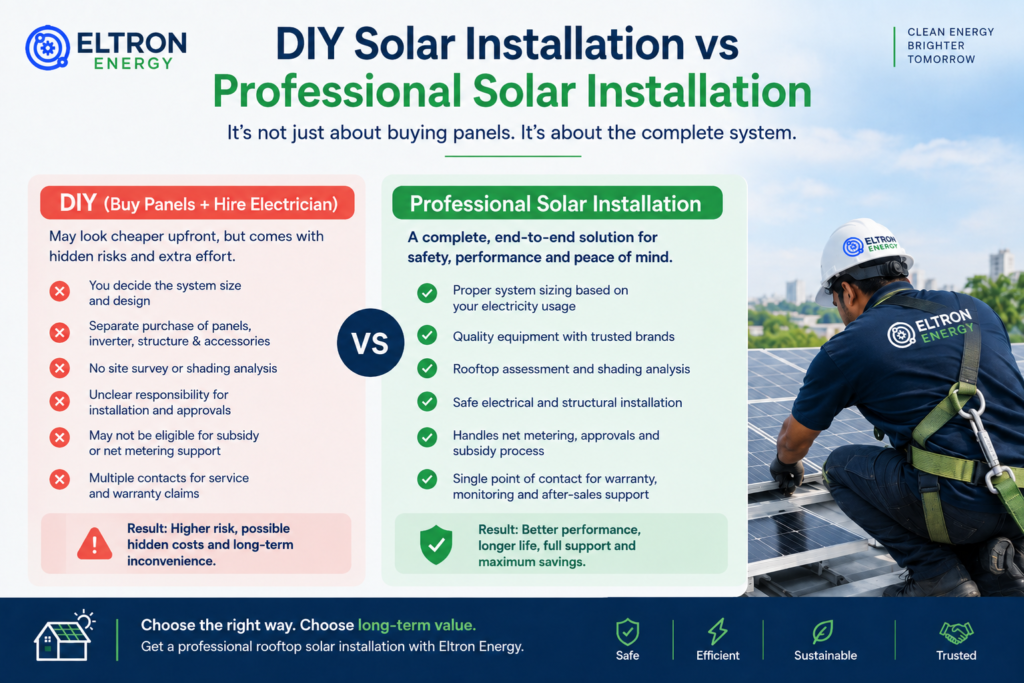
| Area | Buying Equipment Yourself | Professional Solar Installer |
|---|---|---|
| Equipment sourcing | Managed by homeowner | Usually handled by installer |
| System sizing | Must arrange yourself | Usually included |
| Site survey | Must arrange separately | Usually included |
| Solar design | Separate responsibility | Usually included |
| Mounting structure | Must coordinate | Included in project scope |
| Electrical installation | Separate electrician | Coordinated with installation |
| Documentation | May need to manage | Assistance may be included |
| Net metering | Homeowner may coordinate | Installer may handle/assist |
| Subsidy process | Must verify eligibility | Registered installer can guide process |
| After-sales support | Multiple contacts | One primary service contact |
| Accountability | Split between suppliers | More centralized |
The right choice isn’t automatically the most expensive option.
It is the one that gives you the right balance of quality, safety, accountability and lifetime value.
The Biggest Mistake Is Buying Before Designing
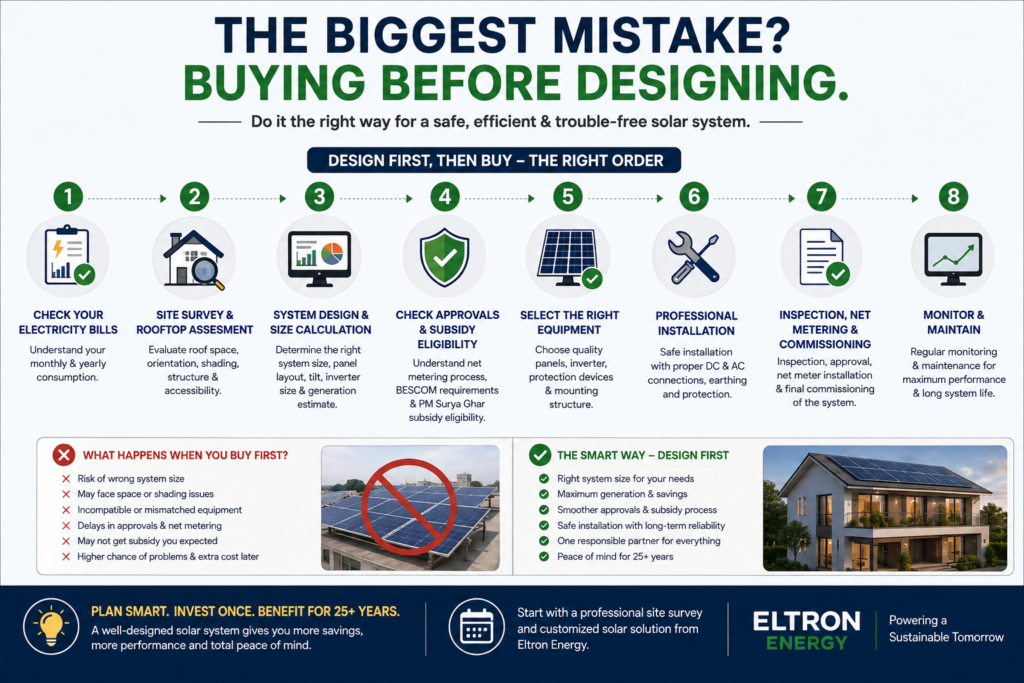
If you remember only one thing from this article, make it this:
Don’t buy the solar panels first.
Design the system first.
Start with your electricity bills.
Then inspect the rooftop.
Calculate the required system capacity.
Check shading and available area.
Select suitable equipment.
Understand the subsidy and net-metering requirements.
Then finalize the equipment.
Doing things in that order can prevent a surprising number of problems.
Get a Rooftop Solar Site Survey in Bangalore
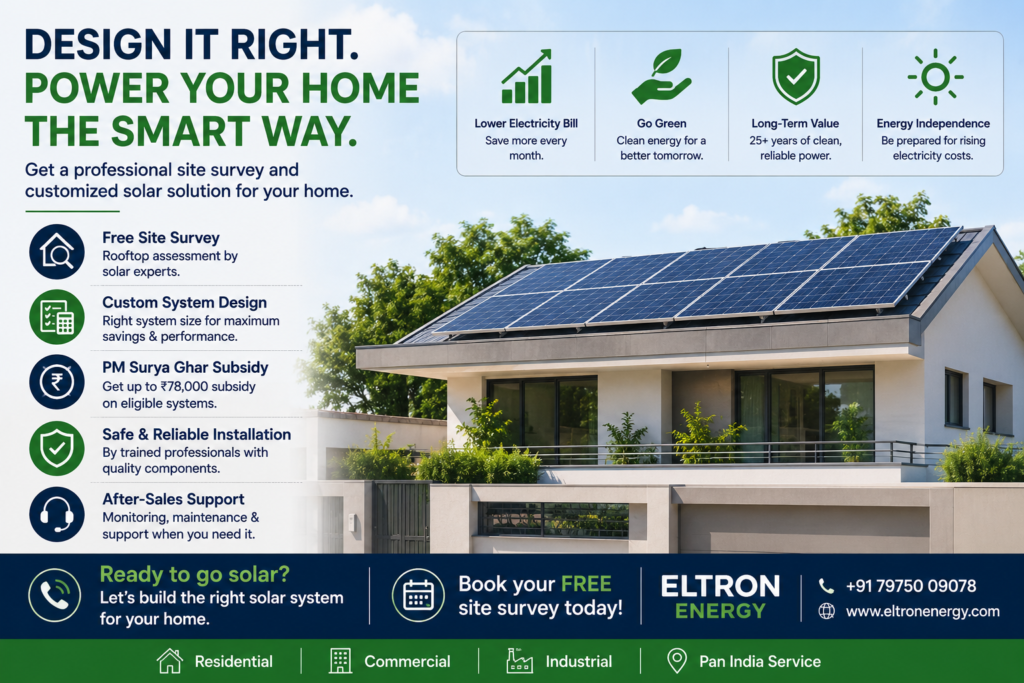
If you’re considering rooftop solar but aren’t sure what system your property needs, start with a professional site assessment instead of starting with a shopping cart.
Eltron Energy provides end-to-end rooftop solar installation solutions for residential, commercial and industrial properties.
The process can begin with your electricity bill and rooftop assessment so that the proposed system is designed around your actual consumption and site conditions.
Instead of purchasing panels first and trying to make them fit later, build the system around your property from the beginning.
Planning rooftop solar in Bangalore or Karnataka? Get a site survey and customized solar quotation from Eltron Energy.